




Why This Matters to Distributors: Amazon is investing to compress the advantages distributors have long held in speed, availability and purchasing workflows, increasing the urgency to differentiate through service, expertise, and digitally enabled customer experiences.
Amazon.com Inc. is expanding deeper into markets long served by wholesale distributors, with CEO Andy Jassy outlining a strategy centered on artificial intelligence, faster delivery, and a sharp increase in capital investment.
In his annual shareholder letter published April 9, Jassy described a company investing at unprecedented scale to expand its reach across procurement, logistics and customer access — areas that align closely with distributors’ traditional strengths.
“We’re not investing approximately $200 billion in capex in 2026 on a hunch,” Jassy wrote. “We’re not going to be conservative in how we play this. We’re investing to be the meaningful leader, and our future business, operating income, and [free cash flow] will be much larger because of it.”
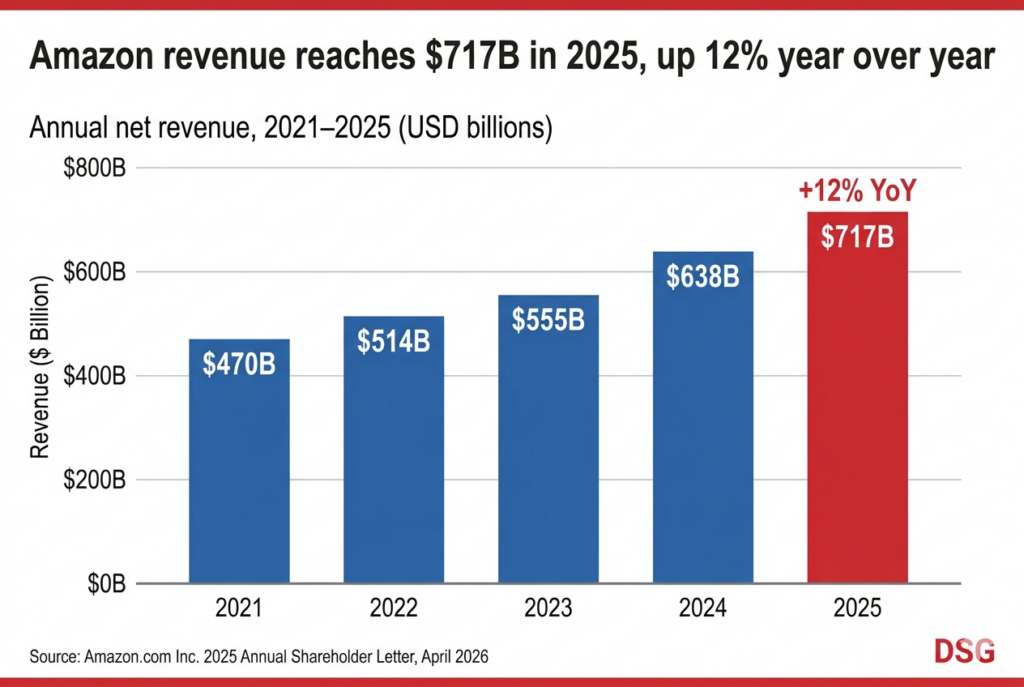
The scope of that investment underscores the stakes. Amazon reported 2025 revenue of $717 billion, up 12% year over year, while operating income rose 17% to $80 billion. Free cash flow declined to $11 billion from $38 billion, reflecting a $50.7 billion increase in capital expenditures, much of it tied to AI infrastructure.
Delivery speed, long a cornerstone of distributor value, is a central focus of Amazon’s next phase. Jassy detailed the expansion of more than 85 same-day fulfillment centers in the United States, capable of delivering 90,000 SKUs within hours. The company is also scaling Prime Air drone delivery, targeting coverage of 30 million customers by the end of the year, and advancing ultra-fast delivery models such as its 20-minute “Amazon Now” service, currently operating at scale in India.
Those efforts are already reshaping customer expectations. Amazon reached same-day grocery delivery coverage in more than 2,300 U.S. cities and towns by the end of 2025, while one-hour delivery is now available for tens of thousands of items in hundreds of markets.
For distributors, that buildout represents a meaningful shift in how speed and availability are defined. The ability to deliver products quickly to job sites and facilities has long differentiated local and regional players. Amazon is investing in narrowing that gap — and in some cases extend delivery capabilities beyond traditional norms.
At the same time, Jassy framed artificial intelligence as the company’s most transformative lever, describing it as “not a standalone initiative — it’s a multiplier” that “will reshape every customer experience we offer and unlock entirely new ones.”
That shift has direct implications for B2B commerce. Amazon Business, the company’s marketplace for organizations, is already embedding procurement workflows into its platform. As AI capabilities advance, those systems could automate tasks traditionally handled by distributor sales teams, including product selection, price comparison, and order execution.
Jassy pointed to the rapid growth of Amazon Web Services’ AI business as evidence of that trajectory. The unit’s AI revenue run rate reached more than $15 billion annually in the first quarter of 2026, up from zero three years earlier.
“Three years after AWS launched commercially, it had a $58 million revenue run rate,” Jassy wrote. “Three years into this AI wave, AWS’s AI revenue run rate is over $15 billion in Q1 2026 — nearly 260 times larger than AWS at that same point.”
He also cited improvements in consumer engagement following the rebuild of the Alexa platform, noting that users are interacting more frequently and completing purchases at significantly higher rates — a signal of how AI-driven interfaces can influence buying behavior.
For distributors, the broader implication is a gradual shift in how purchasing decisions are made, with more activity moving from human-led processes to software-driven workflows embedded in digital platforms.
Amazon is also expanding its reach into rural markets, another area where distributors have historically maintained strong positions. The company is investing $4 billion to grow its rural delivery network and plans to cover more than 13,000 ZIP codes across 1.2 million square miles. Monthly same-day customers in those areas nearly doubled in 2025.
In parallel, Amazon is preparing to launch its low-Earth-orbit satellite network, Project Kuiper, in mid-2026, aiming to expand broadband access and enable digital commerce in underserved regions. The company has already secured agreements with customers including major airlines and telecommunications providers.
The dual investment in logistics and connectivity could reshape access to rural customers, expanding overall demand while also increasing Amazon’s ability to serve those markets directly.
Jassy’s discussion of Amazon’s grocery business provides a roadmap for how the company approaches new categories. After years of experimentation — including the acquisition of Whole Foods Market, the launch of Amazon Fresh and multiple store formats — the business surpassed $150 billion in gross sales in 2025.
He emphasized that progress came through parallel testing rather than a single breakthrough. “If there’s an obvious path to changing your trajectory, take it and run,” Jassy wrote. “But most new jumps forward aren’t like that. There’s invention and experimentation required, and pursuing multiple paths gives you the best chance to find it.”
Amazon Business appears to be following a similar path, steadily expanding product assortment, refining procurement tools, and building out category depth in industrial and commercial markets.
Underlying all of it is capital. Amazon’s investments extend beyond logistics and AI into infrastructure and hardware. AWS added 3.9 gigawatts of power capacity in 2025 and expects to double capacity by 2027. Its custom chip portfolio, including Graviton processors and Trainium AI chips, now generates more than $20 billion in annualized revenue, with new generations already largely reserved ahead of full availability.
For most distributors, matching that level of investment is not feasible. The competitive question is how to respond.
The traditional advantages of the distribution model — local inventory, technical expertise, application support, and established customer relationships — remain intact. But Amazon’s strategy, as outlined by Jassy, is to systematically reduce the gap between those capabilities and what can be delivered through a digital platform.
“Progress will not be linear,” Jassy wrote. “There will be moments of acceleration and moments where we adjust course.”
For distributors, the pace of that acceleration is becoming more visible — and increasingly relevant to how they plan, invest, and compete.
Share this article:
