


Why This Matters to Distributors: Home Depot and Lowe’s have spent billions of dollars buying distributors to expand deeper into professional markets. Walmart takes a different route. It is connecting business purchasing, facilities maintenance, marketplace, fulfillment, supplier freight, data, automation and last-mile delivery into an increasingly integrated platform that overlaps with functions traditionally managed by wholesale distributors.
Walmart is not announcing plans to become a wholesale distributor.
But the world’s largest retailer is steadily building many of the capabilities required to operate like one—and its expansion into commercial facilities maintenance makes the strategy increasingly relevant to wholesale distributors.
Walmart has built a dedicated B2B purchasing operation through Walmart Business, expanded third-party fulfillment, moved farther upstream into supplier transportation, and turned thousands of stores into local fulfillment points. It is integrating the Walmart U.S. and Sam’s Club U.S. supply chains and using its online marketplace to expand its assortment without owning all the inventory.
Now it is also selling commercial maintenance services to other businesses.
In April, Walmart launched Upstream Facility Services, a commercial facilities maintenance business built on the infrastructure it developed to maintain Walmart and Sam’s Club locations. Upstream target’s multi-location businesses and provides HVAC, refrigeration, electrical, plumbing, and general maintenance services, including emergency repairs and preventive and predictive maintenance.
Taken together, the businesses give Walmart an expanding presence in B2B purchasing, product distribution and facilities operations.
And Walmart executives say the broader strategy is increasingly about connecting those capabilities rather than operating them independently.
“We’ve been investing against it for years, and I’m even more bullish today as we see the pieces increasingly powering each other,” CEO John Furner told analysts Aug. 20.
Sales Rise 5.9% in the Second Quarter
Walmart’s strategy is unfolding against an enormous sales base.
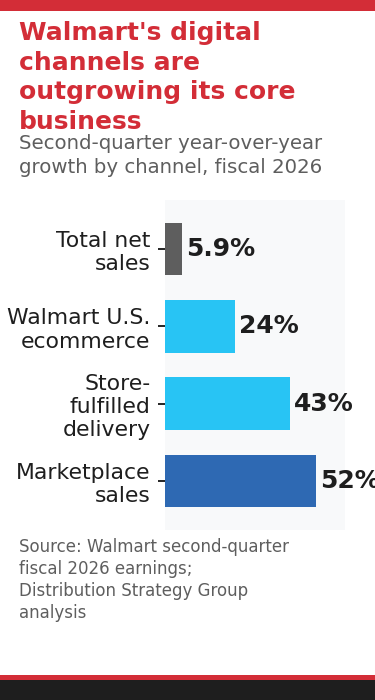
Net sales increased 5.9% to $186.10 billion for the second quarter ending July 31 from $175.75 billion a year earlier. Net income attributable to Walmart declined 9.4% to $6.37 billion from $7.03 billion.
For the first six months of the fiscal year, net sales increased 6.5% to $361.78 billion from $339.73 billion. Net income attributable to Walmart increased 1.6% to $11.70 billion from $11.51 billion.
Walmart U.S. second-quarter net sales increased 3.5% to $125.19 billion from $120.91 billion. Sam’s Club U.S. sales increased 8.8% to $25.71 billion from $23.64 billion.
But some of Walmart’s fastest growth comes from businesses surrounding traditional retail transactions.
Walmart U.S. ecommerce sales increased 24%, including about 43% growth in store-fulfilled delivery and 52% growth in marketplace sales. Sam’s Club U.S. ecommerce sales increased 26%.
That growth is helping Walmart turn its physical network into something much broader than a chain of retail stores.
Walmart Is Going After Facilities Maintenance
The clearest new example is Upstream Facility Services.
Walmart launched the business April 14 to sell the facilities maintenance capabilities it developed internally to outside commercial customers.
Upstream is focused on businesses operating multiple locations and currently provides HVAC, refrigeration, electrical, plumbing, and general maintenance services. Its model includes urgent repairs, preventive maintenance, and predictive service, backed by Walmart-trained technicians and technology that gives customers real-time visibility into service activity across locations.
That puts Walmart directly into a commercial services market connected to wholesale distribution.
A facilities maintenance contract does more than create service revenue. Technicians performing HVAC, refrigeration, electrical, plumbing, and general maintenance work also consume replacement parts, tools, and operating supplies.
For distributors, that creates a potentially important new competitive channel around the products consumed in those workflows.
Walmart has not publicly said Upstream will replace distributors or move all that product purchasing through Walmart’s own channels. But the combination of a national maintenance operation with Walmart’s procurement, inventory and logistics capabilities creates an overlap that distributors serving facilities customers will have to watch.
Walmart Business is simultaneously targeting the product side of facilities operations.
Its facilities offering include hand and power tools, electrical and lighting products, HVAC and air-quality equipment, janitorial supplies, landscaping products, safety products, and other maintenance items. Walmart Business also offers services including building maintenance and repair, installation, and assembly.
That gives Walmart two potential entry points for the same customer: the products needed to operate a facility and the technicians needed to maintain it.
Walmart Business Provides the B2B Front Door
Walmart Business extends the strategy beyond facilities maintenance.
The operation is designed specifically for businesses and organizations, with purchasing capabilities including organizational accounts, multiple users, shared payments, tax-exempt purchasing, and bulk ordering.
That puts Walmart into purchasing workflows traditionally served by distributors and other B2B suppliers.
The potential exposure is particularly significant among small and midsize businesses and organizations that buy large quantities of standardized products.
A restaurant, property manager, school, office, retailer, or other business may still need specialized distributors for technical products and services.
But it does not necessarily need specialized distribution for every purchase.
That creates an opening for Walmart to capture a larger portion of routine business spending.
Marketplace Is Becoming a Distribution Engine
Walmart’s marketplace expands the number of products Walmart can offer without requiring Walmart to own all the inventory.
50% of Walmart’s U.S. marketplace business flowed through Walmart Fulfillment Services during the second quarter, an increase of 4 percentage points from a year earlier.
That is an important distinction.
Walmart is increasingly providing infrastructure other companies use to sell and move their products.
Marketplace expands assortment. Walmart Fulfillment Services provides logistics. Walmart Business provides a B2B purchasing channel. Stores and distribution facilities provide inventory and fulfillment capacity.
Walmart executives describe these operations as parts of a broader platform.
Furner said marketplace, fulfillment services, membership, advertising, and other commerce services are strengthening Walmart’s core business.
Chief financial officer John David Rainey said almost half of Walmart’s operating income growth came from businesses such as membership, advertising, and its marketplace.
“Our business is fundamentally changing,” Rainey said.
Stores Are Becoming Local Distribution Points
Walmart’s physical stores are also taking on a different role.
Walmart U.S. ecommerce now represents more than 23% of sales, twice its share five years ago. Stores manage last-mile fulfillment for 80% of Walmart U.S. ecommerce orders and all its fast deliveries.
Fast delivery increased 48% during the second quarter, and Walmart has expanded delivery in less than 30 minutes to 38 U.S. markets.
Furner described speed as a customer-acquisition tool rather than simply a logistics measure.
“Speed isn’t simply a fulfillment metric, it’s an acquisition strategy,” he said.
That capability could be particularly useful for business and facilities customers that need routine supplies quickly.
A Walmart store stocked with maintenance products and positioned a few miles from a customer can effectively serve as a local inventory point.
Walmart Is Moving Upstream
Walmart is also extending its reach in the opposite direction and toward suppliers.
In May, the company introduced Prepaid Consolidation, a program that allows participating suppliers to send products under a single national purchase order to one location. Walmart consolidates the inventory and distributes it across its 42 regional distribution centers.
Walmart explicitly described the program as an expansion of its “first mile capabilities.”
Suppliers can manage shipments directly through Walmart or use approved third-party logistics providers. They pay a per-case rate covering handling at an automated consolidation center and outbound transportation to Walmart’s regional distribution centers.
The program gives Walmart greater control over inventory before it reaches its traditional distribution network.
Walmart is therefore developing capabilities extending from supplier freight through consolidation, distribution, and fulfillment to final delivery.
Walmart Already Has the Physical Network
The infrastructure supporting that strategy is substantial.
Walmart reported 192 U.S. distribution facilities as of Jan. 31. The network is used by Walmart U.S. and Sam’s Club U.S. and operates through Walmart’s private truck fleet and common carriers.
The company also began combining the Sam’s Club U.S. supply chain function with Walmart U.S. during fiscal 2026 to streamline operations and leverage common enterprise systems and infrastructure.
Automation is increasing the capacity of that network.
Walmart said 3,100 U.S. stores now receive some level of automated freight, while more than half of ecommerce fulfillment volume is processed through automated facilities.
Furner said Walmart’s investments in automation, technology, fulfillment capacity, and its physical network are allowing the company to move inventory more efficiently and support both its own merchandise and Marketplace sellers.
“As we improve density and utilization across our network, speed and profitability reinforce one another,” Furner said.
The economics are familiar to wholesale distributors: Put more volume through existing infrastructure and reduce the incremental cost of serving additional customers.
Home Depot Is Buying Distribution
Walmart’s strategy becomes more distinctive when compared with Home Depot and Lowe’s.
Home Depot has taken the most direct route into wholesale distribution.
Its $18.25 billion acquisition of SRS Distribution in 2024 gave the company a major specialty distribution platform serving professional contractors. Its Pro operations also include HD Supply and Construction Resources, while its acquisition strategy has extended farther into specialty distribution.
Home Depot said in July that its Pro ecosystem included more than 2,360 stores, 1,300 branches, 325 customer-facing warehouses and approximately 16,000 delivery assets.
It also created an Office of Pro Acceleration to coordinate Home Depot Pro, HD Supply, SRS, and Construction Resources and develop shared capabilities including customer relationship management, a common product catalog and optimized fulfillment.
Home Depot estimates the professional market it is targeting at about $700 billion.
Its customer definition is broad. The company specifically includes general contractors, specialty trades and MRO managers maintaining multifamily properties among the professional customers it wants to serve.
Home Depot is therefore buying established distribution capabilities, warehouses, specialized inventories, sales organizations, and delivery infrastructure—and connecting them to its retail network.
Lowe’s Is Building Around the Pro
Lowe’s is pursuing a similar acquisition-driven strategy.
It completed its $8.8 billion acquisition of Foundation Building Materials in October 2025. FBM distributes drywall, metal framing, ceiling systems, commercial doors and hardware, insulation, and related products. At the time the deal was announced, FBM operated more than 370 locations in the U.S. and Canada and served about 40,000 professional customers.
Lowe’s said the acquisition adds faster fulfillment, digital capabilities, trade credit, and cross-selling opportunities.
It also acquired Artisan Design Group for $1.3 billion in 2025, adding design, distribution and installation services for flooring, cabinets and countertops serving homebuilders and property managers.
Those acquisitions have materially increased Lowe’s scale beyond its stores. At the end of fiscal 2025, Lowe’s operated more than 540 branch locations associated with FBM and Artisan Design Group in addition to its traditional home-improvement stores.
The businesses are contributing to Lowe’s growth. Second-quarter sales increased to $26 billion from $24 billion a year earlier. Comparable sales increased just 0.2%, but Lowe’s said Pro, home services and a 15.7% increase in online sales drove growth.
Three Giants, Three Distribution Strategies
The comparison shows three increasingly important competitive models.
Home Depot is buying deeply into wholesale distribution. SRS, HD Supply, and its other Pro businesses give it specialized branches, warehouses, sales organizations and delivery capabilities across construction and MRO markets.
Lowe’s is using Foundation Building Materials and Artisan Design Group to extend beyond its retail stores into specialty distribution, installation, and larger professional accounts.
Walmart is approaching the market differently.
It is building from assets and capabilities it already owns.
Walmart Business provides the B2B purchasing channel. Marketplace expands assortment. Walmart Fulfillment Services provides third-party logistics. Sam’s Club provides another commercial purchasing channel. Stores provide local inventory and fulfillment. Walmart’s distribution network provides national scale. Prepaid Consolidation moves the company farther upstream into supplier logistics.
And now Upstream Facility Services puts Walmart technicians inside commercial facilities performing HVAC, refrigeration, electrical, plumbing, and general maintenance work.
Home Depot and Lowe’s are moving primarily deeper into professional construction and MRO through acquisitions.
Walmart is potentially moving horizontally across a broader range of business operations — purchasing products, maintaining facilities, moving inventory, and delivering products.
Walmart Doesn’t Need to Replace the Distributor
That may be the most important distinction for distributors.
Walmart does not need to duplicate the full capabilities of a specialized MRO or facilities maintenance distributor to take a larger share of business purchasing.
Traditional distributors provide deep product expertise, specialized inventories, safety and compliance support, inventory-management services, technical assistance, and other capabilities that Walmart Business does not necessarily provide.
But many facilities purchases do not require that level of support.
Businesses routinely buy cleaning products, paper goods, trash liners, breakroom supplies, batteries, basic tools, office products, safety supplies, and other everyday operating items. Walmart Business already markets facilities products including tools, electrical and lighting products, HVAC equipment, and janitorial supplies.
Those recurring purchases are where Walmart’s combination of price, assortment, local inventory, and rapid delivery can become more competitive.
A facilities department could continue relying on specialized distributors for technical products and services while shifting a larger portion of routine replenishment spending elsewhere.
Walmart therefore does not have to displace an incumbent distributor entirely.
It only captures a larger share of the customer’s purchasing wallet.
That same dynamic can extend beyond facilities maintenance. Specialized electrical, HVAC, industrial and building-products distributors retain advantages in technical expertise and product depth, but Walmart can compete for the broad range of less-specialized products their customers also purchase.
The strategy is less about replacing traditional distribution than potentially unbundling pieces of the distributor-customer relationship — particularly high-frequency, standardized purchases that can move efficiently through Walmart’s existing network.
The Bigger Threat Is the Combination
No single Walmart initiative makes the company a wholesale distributor.
The significance is in how the pieces fit together.
More marketplace sellers increase assortment. More assortment attracts customers. More customers increase delivery density. Greater density improves fulfillment economics. Faster delivery encourages customers to shop more frequently. More transactions generate more data, and that data makes Walmart’s advertising and supplier services more valuable.
The physical supply chain reinforces the digital businesses, and the digital businesses put more volume through the physical network.
Furner described that cycle during the earnings call.
“When we invest in our supply chain, it helps us get more products to our customers and members faster,” he said. As purchasing frequency increases, he added, suppliers and sellers want to be closer to the point of purchase.
That is what separates Walmart’s strategy from those of Home Depot and Lowe’s.
Home Depot and Lowe’s have bought distributors and are integrating those businesses into larger Pro platforms.
Walmart is building something different: a network connecting commerce, fulfillment, supplier logistics, local delivery, business purchasing and now commercial facilities maintenance.
Walmart may never call that wholesale distribution.
For distributors, the label matters less than the capabilities.
Home Depot and Lowe’s are already competing more directly for business historically handled by distributors.
Walmart is coming from another direction.
Share this article:
