




Why This Matters to Distributors: Manufacturing job displacement is rising sharply, particularly in durable goods. Plant closures eliminated shifts and workforce reductions can mean lower product demand, lost accounts, and changing sales opportunities for industrial distributors.
U.S. manufacturers displaced 642,000 long-tenured workers from 2023 through 2025, an increase of more than 50% from the previous three-year period, according to new data released Thursday by the U.S. Bureau of Labor Statistics.
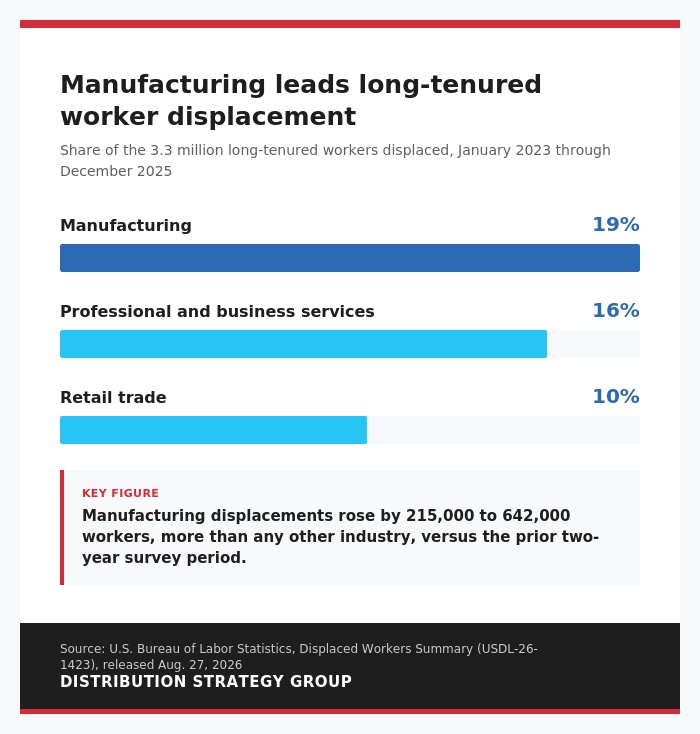
The number increased by 215,000 from 427,000 during 2021-2023. Manufacturing accounted for 19% of all long-tenured workers displaced during the latest period, the largest share of any industry.
The increase was concentrated in durable goods manufacturing, a key customer base for industrial distributors.
BLS counted 447,000 displaced long-tenured workers in durable goods manufacturing during 2023-2025, up from 265,000 during 2021-2023. That was an increase of 182,000, or 69%. Durable goods accounted for about 70% of all manufacturing displacement during the latest period.
The numbers provide another measure of the restructuring underway across parts of the U.S. industrial economy. Unlike monthly employment reports, the BLS displacement data track workers who lost jobs because plants or companies closed or moved, there was insufficient work, or positions or shifts were eliminated.
For distributors, those reasons can be important indicators of changes in customer demand.
A manufacturer cutting shifts or eliminating positions may consume fewer safety products, cutting tools, electrical supplies, fasteners, and other production-related products. Plant closures can eliminate local accounts, while consolidations and relocations can shift purchasing volume to other facilities, markets, or suppliers.
The latest BLS figures do not indicate an across-the-board manufacturing contraction. They do show that displacement has accelerated among manufacturers, particularly durable goods producers.
Manufacturing accounted for 19% of long-tenured displaced workers during 2023-2025, up from 17% during the previous survey period. Professional and business services accounted for 16% of displaced workers, while retail trade accounted for 10%.
Worker displacement also increased across the broader U.S. economy.
BLS said 3.3 million workers were displaced from jobs they had held for at least three years during 2023-2025, an increase of 746,000 from the previous three-year period. Another 4.1 million workers lost jobs they had held for less than three years.
In total, 7.4 million U.S. workers were displaced during the period, up from 6.3 million in the previous survey.
Position and shift elimination was the most common reason long-tenured workers lost their jobs. About 44% were displaced because their position or shift was eliminated, while 33% lost jobs because a plant or company closed or moved. About 23% were displaced because there was insufficient work.
Those causes make the numbers particularly relevant to distributors because they can directly affect activity at customer facilities. Fewer shifts and employees can reduce consumption of production and maintenance supplies, while closures and relocations can permanently alter a distributor’s local customer base.
Many displaced workers also continued to face a difficult labor market.
As of January, 66.1% of the 3.3 million long-tenured displaced workers had found new jobs. Another 18.3% were unemployed and 15.7% had left the labor force.
Workers who found new jobs frequently did not recover their previous earnings.
Among long-tenured workers who lost full-time wage and salary jobs and subsequently returned to full-time employment, only about 49% of those reporting earnings were making as much or more than they had earned in their previous jobs. That was down from about 62% in the January 2024 survey.
The reemployment rate for workers displaced from production, transportation and material-moving occupations was 65.3%. Workers displaced from natural resources, construction and maintenance occupations had a 67.4% reemployment rate.
The manufacturing figures represent a significant shift from the previous BLS survey. Manufacturing displacement increased from 427,000 long-tenured workers during 2021-2023 to 642,000 during 2023-2025. Durable goods manufacturing accounted for most of that increase, rising from 265,000 displaced workers to 447,000.
For industrial distributors, the numbers add another indicator to watch alongside manufacturing production, capacity utilization, new orders, and customer capital spending. Rising displacement does not necessarily signal broad manufacturing weakness, but plant closures, reduced shifts and job eliminations can provide early evidence of changing demand at individual customers and within local industrial markets.
Do not miss any content from Distribution Strategy Group. Join our list.
Share this article:
