


Why This Matters to Distributors: The S&P Global report points to a potential return of supply chain conditions like those seen during the pandemic, with rising freight costs, longer replenishment cycles, and rapid pricing changes. Distributors that invested in forecasting, supplier diversification and dynamic pricing capabilities may be better positioned to manage another period of cost volatility and supply uncertainty.
Global supply chain disruptions tied to the war in the Middle East are driving manufacturing costs sharply higher and increasing pressure on distributors already managing volatile freight rates, tariff uncertainty and shifting supplier costs, according to new research from S&P Global.
In a May 5 report, S&P Global said producer input costs rose in April at the fastest pace since June 2022 as manufacturers faced higher energy prices, shipping disruptions, and worsening supplier delivery delays.
The report said rising energy prices and disruptions tied to the closure of the Strait of Hormuz are increasing transportation and sourcing costs across global manufacturing supply chains. S&P Global also said higher shipping costs are affecting factory inputs and manufactured goods at levels not seen in four years.
“The PMI’s Supplier Delivery Times Index signaled the greatest lengthening of lead-times since August 2022 in April,” Chris Williamson wrote in the report.
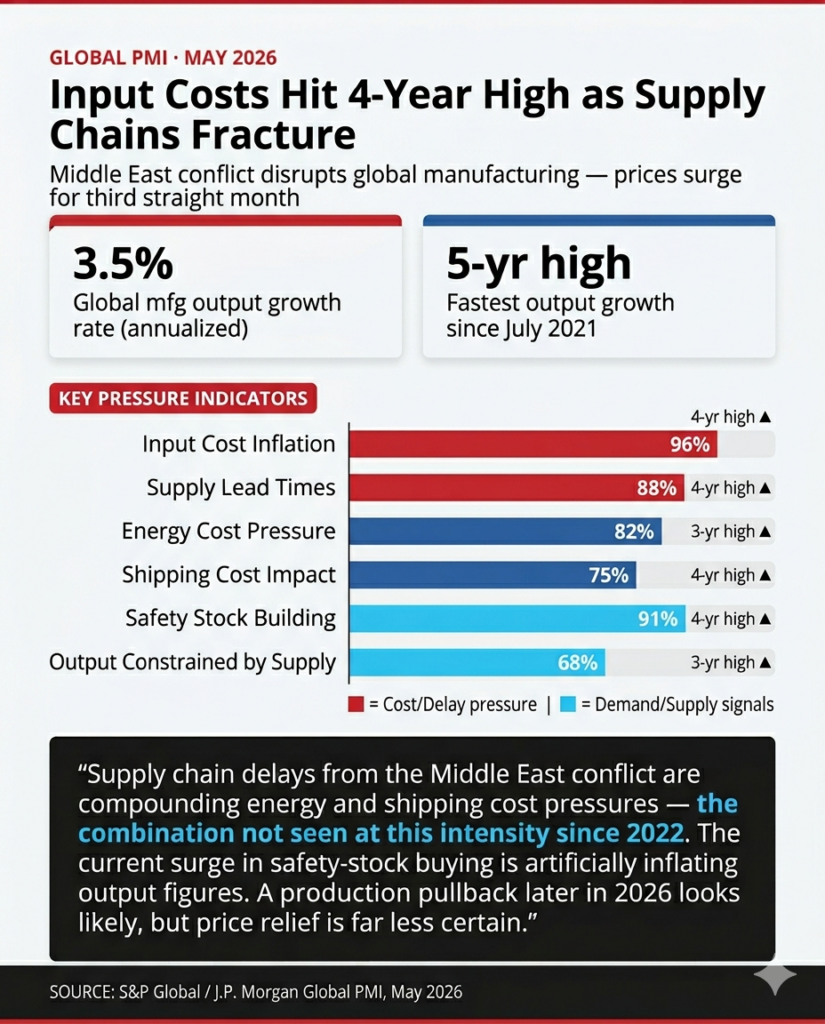
Manufacturers also are increasing inventory purchases and building safety stock to protect against additional shortages and future price increases, S&P Global said. The report found that purchasing activity tied to safety stock building reached its highest level since June 2022 and was near levels seen during the pandemic supply chain crisis.
At the same time, global manufacturing output accelerated in April to its fastest pace since July 2021, with output expanding at an estimated 3.5% annualized rate.
But S&P Global warned the increase may be temporary because much of the growth appears tied to precautionary inventory building rather than sustained end-market demand.
“The concern is that this stock building is providing only a temporary boost to manufacturing output, while simultaneously putting upward pressure on prices,” Williamson wrote.
The report also said supply shortages are already constraining factory production at the highest level since October 2022.
Distributors are beginning to see the impact.
During its recent earnings call, Global Industrial Company chief financial officer Tex Clark said the company expects second-quarter revenue growth to remain in the mid- to high-single-digit range but warned that fuel surcharges and transportation costs are expected to pressure margins in coming months.
“We continue to closely monitor the macroeconomic and geopolitical environment, including developments in the Middle East and their impact on transportation and manufacturing costs, as well as the evolving tariff landscape,” Clark said.
Chief executive officer Anesa Chaibi said the company has adopted more dynamic pricing systems to respond faster to tariffs and supplier cost changes.
“What we have inherently in the business now is initiative-taking pricing,” Chaibi said. “We are watching real time and reacting dynamically from a margin perspective.”
The comments reflect a broader shift across distribution toward faster pricing adjustments and more automated pricing tools as freight costs, tariffs and supplier pricing become increasingly volatile.
Industrial, HVAC, electrical and building supply distributors are especially exposed because many product categories rely on imported materials, globally sourced components, and energy-intensive manufacturing.
Longer supplier lead times and higher freight costs could force distributors to hold more inventory while adjusting pricing more frequently to protect margins. At the same time, distributors risk carrying excess inventory later this year if current stockpiling activity fades and demand weakens.
S&P Global also warned that supply chain disruptions typically take about six months to feed through to broader consumer inflation, signaling that pricing pressure could continue building through the second half of 2026.
Do not miss any content from Distribution Strategy Group. Join our list.
Share this article:
