


Why This Matters to Distributors: New warehouse investments across industrial, electrical, fastener and PVF distribution show that faster delivery and regional inventory positioning have become competitive necessities rather than differentiators.
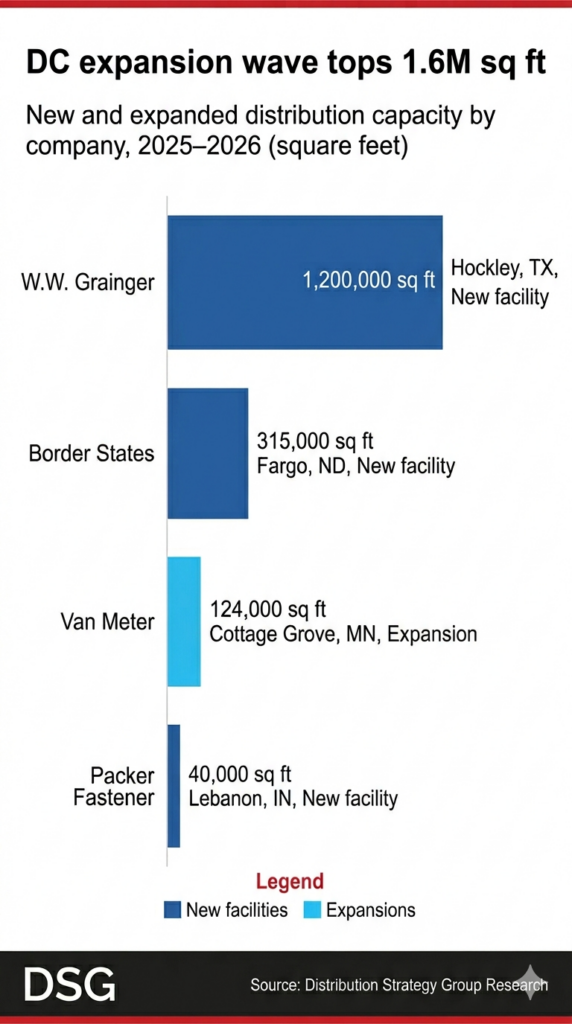
Wholesale distributors across multiple industry sectors have committed more than 1.6 million square feet of new and expanded distribution capacity as companies accelerate efforts to place inventory closer to customers and shorten delivery times.
The projects include newly opened facilities in Indiana and Southern California, a major expansion in Minnesota, and large distribution centers under construction in Texas and North Dakota. Together, they highlight a broader shift across wholesale distribution as companies invest in regional fulfillment networks to improve service levels, increase product availability, and support growth in key markets.
The largest project belongs to W.W. Grainger, which is constructing a 1.2 million-square-foot distribution center in Hockley, Texas, about 37 miles northwest of Houston. The facility, which broke ground in October 2024 and is expected to open later this year, will stock more than 250,000 industrial products and employ approximately 400 workers within its first year of operation.
Grainger said the facility will more than double the number of stocked products available to customers in the Houston market, increasing inventory from about 150,000 items to more than 300,000.
Border States is preparing to open its first dedicated regional distribution center in Fargo, North Dakota, this fall. The 315,000-square-foot facility, which broke ground in June 2025, will support 28 branch locations across eight Upper Midwest states.
The electrical distributor has implemented warehouse and labor management systems from Blue Yonder to support operations and said the facility is expected to create more than 60 jobs. The company has also indicated plans to develop additional regional distribution centers in other parts of the country.
Van Meter broke ground April 29 on a 124,000-square-foot expansion of its regional distribution center in Cottage Grove, Minnesota. The project will increase the facility’s footprint to 315,000 square feet and incorporate automated warehouse technology from Hai Robotics.
The expansion will consolidate two existing facilities into a single operation handling inventory management, order fulfillment, and wire and cable processing. Construction is expected to continue through 2027, with full operational deployment targeted for 2028.
In Indiana, Packer Fastener opened a 40,000-square-foot distribution center in Lebanon on June 1. The facility serves commercial contractors, manufacturers and fabricators operating in data centers, renewable energy, and power generation markets.
The Lebanon location marks the Green Bay, Wisconsin-based distributor’s 12th facility and expands its presence into a ninth state. Since late 2024, the company has added distribution centers in Kansas City, Columbus, Atlanta, and Indianapolis, along with branch operations in Mississippi and Iowa.
Everflow Supplies also expanded its footprint this year with the opening of a distribution center in Eastern Los Angeles, the company’s first facility on the West Coast. The new location strengthens service coverage across Western states and provides an additional import gateway beyond East Coast and Gulf Coast ports.
The facility supports Everflow’s wholesale customers in plumbing, HVAC, industrial, mechanical and fire protection markets.
While the projects vary in size and stage of development, several common themes are emerging. Companies are targeting regions experiencing strong manufacturing, construction, and infrastructure investment, including Greater Houston, the Upper Midwest, Southern California, and the Indianapolis market. Automation is also becoming a standard component of new warehouse development, with distributors increasingly incorporating robotics, warehouse management systems and advanced inventory technologies into facility designs from the outset.
The expansion activity reflects growing pressure on distributors to improve fill rates, increase inventory availability and shorten delivery windows. As customer expectations continue to rise, regional distribution infrastructure is becoming a core competitive requirement across many sectors of wholesale distribution.
For distributors serving the same markets, the investments raise the competitive bar. Companies with strategically located inventory and modern fulfillment capabilities are increasingly positioned to win business based on service levels, product availability, and delivery speed rather than price alone.
Do not miss any content from Distribution Strategy Group. Join our list.
Share this article:
