



Why This Matters to Distributors: Stronger business and consumer spending is supporting demand across many of wholesale distribution’s largest customer markets. At the same time, accelerating price inflation and persistent supply chain disruptions are increasing procurement costs and raising the likelihood of another round of supplier price increases heading into the fourth quarter.
The U.S. services sector expanded at its fastest pace in eight months in July, strengthening the outlook for many wholesale distributors as domestic demand accelerated despite mounting inflation and ongoing supply chain disruptions, according to S&P Global Market Intelligence’s flash Purchasing Managers’ Index survey released Friday.
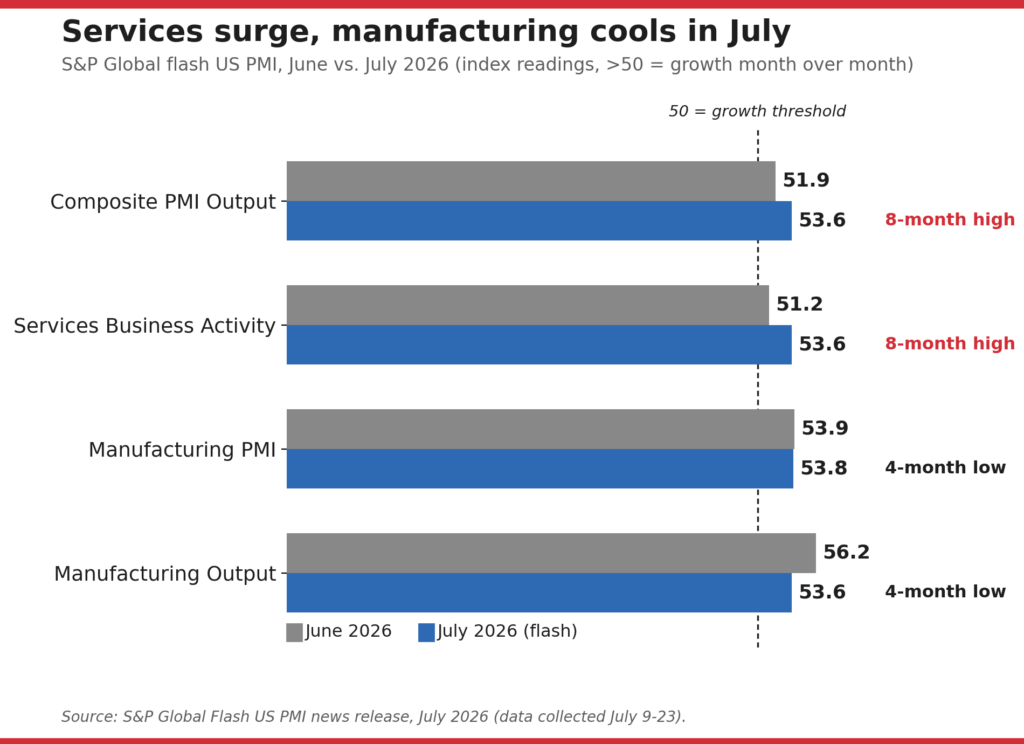
The Services Business Activity Index rose to 53.6 in July from 51.2 in June, its highest reading since November. The gain lifted the flash Composite PMI Output Index, which measures activity across the manufacturing and services sectors, to 53.6 from 51.9, also an eight-month high. Readings above 50 indicate month-over-month expansion.
S&P Global attributed the stronger performance to increased domestic spending, including business investment, stronger-than-normal Fourth of July activity and spending related to the FIFA World Cup. Exports of goods and services continued to decline, indicating July’s growth was driven entirely by the domestic economy.
Businesses also reported stronger new order activity, prompting companies to add workers for the first time in three months after two consecutive months of net job losses.
For distributors, the report points to healthier demand across service-oriented markets, including healthcare, hospitality, facilities management, commercial construction, and business services, where customer spending has remained resilient despite economic uncertainty.
The survey also indicates that businesses continue investing in sales, marketing, and product development, supporting demand for maintenance, repair and operations products, electrical equipment, safety supplies, janitorial products, and other categories commonly sold through wholesale distribution.
The stronger demand environment, however, was accompanied by renewed inflationary pressure.
Input costs increased at their fastest pace since May 2025, driven primarily by rising costs in the services sector. Businesses passed more of those costs to customers, pushing selling-price inflation to its highest level since August 2022. Services companies recorded their fastest rate of price increases in four years.
For distributors, that suggests suppliers could continue implementing price increases during the second half of the year, placing greater emphasis on pricing discipline and margin management.
Manufacturing remained in expansion territory but continued to lose momentum.
Factory output slowed from June, while manufacturers reported supplier delivery times lengthened for an 11th consecutive month, the longest stretch since August 2022. Companies cited shipping disruptions through the Strait of Hormuz, tariff-related sourcing challenges, and increased safety-stock purchases as key factors behind the delays.
Although manufacturing played a smaller role in July’s economic growth, the deterioration in supplier delivery times remains significant for distributors because it points to continued pressure on product availability and replenishment cycles.
Chris Williamson, chief business economist at S&P Global Market Intelligence, said the July survey is consistent with annualized U.S. gross domestic product growth of about 2.0% in the third quarter, up from an estimated 1.2% pace in the second quarter.
Williamson cautioned that some of July’s strength may prove temporary because it reflected spending tied to the FIFA World Cup and Independence Day celebrations. He also warned that escalating tensions in the Middle East could further disrupt global supply chains and add to inflationary pressures.
The report reinforces three themes distributors should monitor heading into the fourth quarter.
First, domestic demand remains healthy, particularly among service-sector customers, providing continued support for sales growth outside traditional manufacturing markets.
Second, pricing pressure is building again. Rising services-sector inflation increases the likelihood of additional supplier price increases, requiring distributors to carefully balance margin preservation with customer pricing expectations.
Third, supply chain conditions remain fragile. Supplier delivery times have now lengthened for 11 consecutive months, suggesting procurement teams should continue planning for extended lead times, particularly for imported products and categories dependent on shipping routes through the Middle East.
Final July Purchasing Managers’ Index data will be released Aug. 3 for manufacturing and Aug. 5 for services, providing a clearer picture of whether July’s acceleration represents a sustained improvement in business activity or a temporary boost from seasonal spending.
Do not miss any content from Distribution Strategy Group. Join our list.
Share this article:
