



I’ve run customer experience for several distributors, and the one thing consistent across all of them is this: the good ones understand that customer experience isn’t left to the customer service team alone. It takes a cross-functional team to find where your customer experience is weak, start with the customer, and improve it.
I was lucky enough to begin my career at Grainger, and they taught me early that the lens of the customer is the most important one you have. What I learned there, and with every company since, is that looking at the business through the lens of the value stream is how you make improvements that matter.
At one of those companies, I watched a good account walk out the door, and not one department thought it was their fault. Sales had hit quota on that account. Customer service had closed every ticket inside its service window. The warehouse posted a 98% fill-rate that month. Credit has done its job protecting us from a slow-pay risk. Every scoreboard reads green. The customer still left and took 11 years of purchases with them.
The bottom line: customer experience is a company-wide responsibility that crosses every function you run. It must be a team effort because no other way works. Most distributors manage it as if a single team can own it. That’s backwards. And it’s why so many improvement efforts stall after the first survey.
The Myth of Customer Experience (CX) Ownership
The instinct, when a leadership team decides customer experience matters, is to name an owner. Hand it to marketing because they run surveys. Hand it to customer service because they answer the phones. Create a customer experience (CX) manager and check the box.
Back at Grainger, we relied heavily on cross-functional teams, and the person in charge usually wasn’t from customer service. It was the person who could impact that problem the most. Their job ran past their own department. They had to bring the rest of the departments along, so that when we implemented a solution it didn’t break something else in the value chain. That distinction matters.
Here’s the reality of our industry. There’s rarely a formal customer experience (CX) title. Marketing usually spearheads the data because they own the survey. You can even name an owner. None of that changes what the work is. Whoever you put in charge inherits responsibility for an outcome and authority over almost none of the inputs. They can’t set credit policy. They can’t change the warehouse slotting that drives short ships. They can’t rewrite how sales set delivery expectations. So, they do the one thing within reach: they send more surveys, build prettier dashboards, and watch the number sit flat, while the actual drivers of dissatisfaction live in the other departments that never got the memo.
You can assign a steward for customer experience. You cannot delegate it. Those are different things and confusing them is where most distributors get stuck.
Why Customer Experience (CX) is a Team Sport
Walk one order through your building and watch how many hands touch the customer.
Marketing sets expectations before the customer ever calls. Sales make the promise on price, availability, and delivery. Customer service fields the question when something’s unclear. Operations and the warehouse pick, pack, and ship it, and decide whether it arrives complete and on time. Inventory and supply chain decide whether the item was even there to sell. Finance, through credit and billing, decides whether the order ships today or sits on hold, and whether the invoice is clean or triggers a dispute. Executive leadership decides whether any of these groups get measured on the customer’s experience or only on their own departmental number.
Lay your touchpoints out on a wall and you’ll count a lot more boxes than people. They don’t map one to one. Eight or nine names end up owning all of them, and which names matter depends on the touchpoint you decide to fix. The divisions are also finer than the organizational chart admits. Inside finance alone, the credit manager who puts an order on hold isn’t the billing clerk who lets a bad invoice go out. Same department, two different players, two different ways to lose a customer.
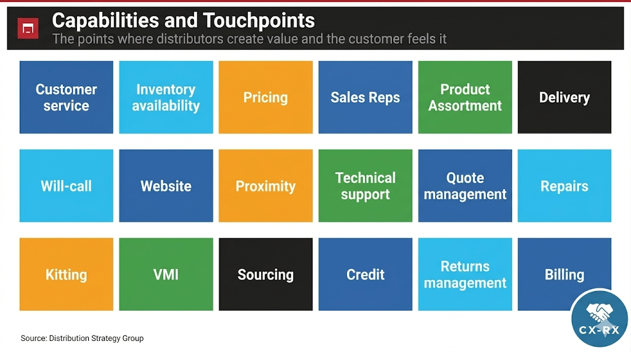
The customer doesn’t see eight or nine departments. They see one company, and they judge you on the weakest link in the chain. A flawless sales relationship doesn’t survive, a billing department that fights every credit. A great price doesn’t survive, a backorder nobody communicated.
The Problem with Departmental Thinking
Now it gets dangerous. Every department optimizes the metric it’s measured on, and each one looks like a winner while the customer’s experience erodes.
Say you’ve got a credit problem. The worst thing you can do is hand it to the credit manager and tell them to fix it. They will. They’ll fix it for credit, optimize it for their number, and in the process create a problem for sales, for service, for inventory. The fix is local and the damage is company wide. Multiply that across every function: credit tightens terms to protect days sales outstanding (DSO), and a customer who’s bought from you reliably for a decade gets treated like a flight risk. The warehouse hits its fill-rate target by shipping the easy lines complete and shorting the one item the customer built their job around. Sales books the order and moves on, never flagging that the delivery date was optimistic. Each manager defends their number on Monday. Each number is real. The customer is still unhappy, and no single report shows why.
This is the part operators understand from the plant floor: you can run every workstation at peak efficiency and still ship a bad product, because the problem lives in the handoffs, not the stations. Customer issues always originate in one department and surface in another. The credit hold becomes the service team’s angry phone call. The slotting decision becomes the salesperson’s lost renewal. Look at only department by department and you’ll never find the root cause, because the root cause is the seam between two departments that don’t share a scoreboard.
A Value-Stream Approach to Customer Experience
Stop managing customer experience as a set of departments and start managing it as a value stream. A value stream is the full end-to-end sequence of activities that carries a customer from first request to delivered product—the whole path, not any one department’s piece of it. It’s the same discipline you’d apply to any operational process improvement, pointed at the customer instead of the warehouse.
One of the companies I worked with made every one of us own a value stream. Not in your department. A value stream that cut across all of them. Owning it meant owning the whole path—the handoff coming into each department, the work that happened inside it, and the handoff back out to the next one. You had to walk into credit, into the warehouse, into billing, into customer service, and learn what each group did, how they did it, and how their piece landed on the customer. It was uncomfortable, and it was the most useful thing I did that year, because it forced me to see the handoffs instead of the boxes. That’s what real ownership of customer experience looks like: somebody who can shepherd a problem all the way through the organization rather than optimize one stop on it. Doing it this way forces you to think of the customer first and see it through that lens.
Map the full journey the way the customer travels it: discovery, quote, order, credit approval, fulfillment, delivery, invoicing, support, reorder. Then ask three questions at every step. Who owns this touchpoint? What does the customer expect here? And how do we know whether we’re delivering it? Most distribution leaders can’t answer the third question with data at more than half the steps. That gap is the whole problem.
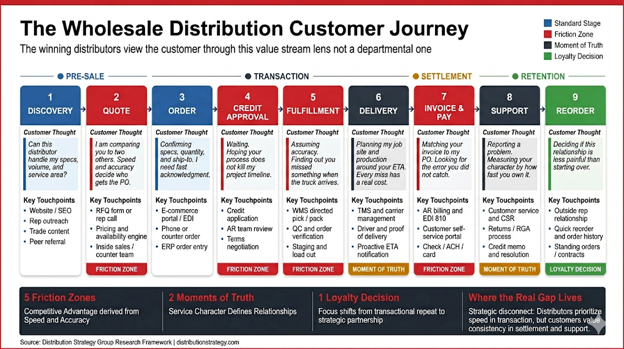
A value stream needs shared visibility. Everyone must see the same customer, the same feedback, the same metric, at the same time. The credit manager needs to see that the account they just put on hold is one your top rep has been nurturing for two years. The warehouse needs to see that the line they shorted last week is the reason a customer rated delivery a two. When the data sits in silos, nobody owns the seams, and the seams are where you lose customers.
How the Cross-Functional Team Operates
A cross-functional team lives or dies on how it’s run. I won’t tell you what your org chart should look like, because a single-branch distributor and a national platform don’t share one. The mechanics, though, travel everywhere. Five rules separate a committee that meets from a team that moves.
Pick the lead by leverage, not title. The person who can move the problem the most runs the team, whether that’s the credit manager, the ops lead, or a service supervisor. When the problem changes, the lead changes.
Charter it around the value stream, not a department. The mandate is the customer’s path through the issue, start to finish. The lead doesn’t fix their own piece and hand it off. They carry the fix across every department it touches.
Put everyone on one scoreboard. While the team is working, every member is measured on the customer outcome, not their own departmental number. Drop that rule and the credit manager goes right back to protecting days sales outstanding (DSO).
Give it decision rights and a clock. The team meets on a fixed cadence, makes calls that cross department lines, and escalates the minute it hits a wall it can’t clear. A team that needs permission for every cross-functional move die of slowness.
Disband it when the seam is fixed. Then stand up the next one around the next problem. The capability is permanent. Any single team is temporary.
Get those five right and you stop coordinating departments. You start moving as one company toward the customer.
How Technology Enables Cross-Functional customer experience (CX) Management
This is where good intentions die for a practical reason: you can’t shepherd a problem across eight or nine departments if you can’t see the customer in one place. Spreadsheets, an annual survey, and a gut feel won’t get you there. You need a dedicated customer experience platform built to do the cross-functional work, not just collect feedback.
A platform earns its place when it does three things your spreadsheets can’t. It centralizes feedback so every department reads from the same source instead of trading anecdotes. It surfaces the ownership gaps, the touchpoints where the customer is struggling and no one’s accountable. And it shows you how much each capability matters to the customer, not only how you score on it, so you invest where it moves the relationship instead of where it’s easy.
That’s the design philosophy behind Customer Experience RX, the platform we built at DSG specifically for distributors. It puts importance and performance side by side on every capability, benchmarks you against other distributors, and lets you slice feedback by segment, geography, and job function in one portal every department can open. One distributor used it to target the improvements that mattered most to their customers and moved their Net Promoter Score from 57 to 70 in a single year.
What matters is what the tool makes possible: one version of the truth is that finance, sales, service, and operations all trust enough to act on together. A platform won’t fix your customer experience. It gives your leadership team the shared visibility and accountability to fix it themselves.
The Leadership Takeaway
Customer experience is the main differentiator left in distribution. Product lines converge, prices get matched, and the company that wins is the one the customer trusts to get it right across the whole relationship. That’s a leadership problem before it’s a software problem.
What changes Monday morning:
Stop asking which department owns customer experience. Own it yourself, at the leadership level, and build the cross-functional team to carry it, led by whoever can impact the problem most and bring the other departments along. Map the value stream. Put one source of customer truth in front of all eight or nine stakeholders. Measure importance alongside performance so you invest in what customers value. Then do the unglamorous work of fixing the seams between departments, because that’s where your customers are quietly deciding whether to stay.
Your competitors are still arguing about whose fault the last lost account was. Get your teams looking at the same customer, and you’ll stop having that argument. That’s the game.
Share this article: