


Why This Matters to Distributors: QXO’s next competitive advantage won’t come from another blockbuster acquisition. Instead, the company is betting that technology, procurement, pricing discipline, and cross selling across a $18 billion distribution platform will deliver faster growth and higher margins, increasing competitive pressure on regional and national building products distributors.
QXO is entering a new phase of its growth strategy, shifting its focus from assembling one of North America’s largest building products distribution platforms to integrating its acquisitions and improving operational performance through technology, pricing, and procurement.
In a 12-page investor question-and-answer document released July 9, the company outlined how it plans to extract value from its acquisitions of Beacon, Kodiak Building Partners, and TopBuild. Together, those businesses give QXO approximately $18 billion in annual revenue, $2 billion in adjusted EBITDA, about 28,000 employees and 1,150 locations across all 50 U.S. states and seven Canadian provinces.
The strategy marks a shift from acquisition driven expansion to execution.
After completing three transformative acquisitions over the past year, QXO said its immediate priorities are integrating the businesses, paying down debt, and improving operational performance rather than pursuing another large transaction. While the company said tuck-in acquisitions remain part of its long-term strategy, management said the near-term emphasis is on integration, technology deployment, customer experience, and operating improvement.
The company believes building products distribution remains significantly under-digitized, creating opportunities to improve both customer service and profitability by modernizing operations.
QXO said it is investing in enterprise resource planning software, warehouse management systems, customer relationship management platforms, pricing software, point-of-sale systems, transportation management, and e-commerce capabilities. The company said those systems are intended to improve inventory visibility, pricing accuracy, branch productivity, procurement, route optimization, and invoice accuracy while giving customers a faster, more digital purchasing experience.
The rollout will occur in phases. QXO said the core Beacon technology implementation is expected to be complete by the end of the first quarter of 2027, with Kodiak and TopBuild following by the end of the third quarter of 2027. The company said the new point-of-sale system is designed to replace legacy AS/400 workflows with a mobile-enabled platform that also prompts sales associates to recommend complementary products and private-label alternatives during customer transactions.
Technology is only one part of the company’s operating model.
QXO identified procurement, pricing discipline, inventory optimization, transportation, sales force effectiveness, and cross-selling as the primary operational levers it expects to drive earnings growth over the next several years. Rather than relying on stronger housing markets or increased construction activity, the company said it believes those internal improvements can expand margins even if market conditions remain weak.
Executives also highlighted TopBuild as a key strategic addition because it extends QXO beyond wholesale distribution into installation services. TopBuild crews visit approximately 22,000 job sites each day, giving QXO direct visibility into construction activity, project timing, and product requirements.
The company said that information should improve demand forecasting, inventory placement and procurement while creating opportunities to sell additional product categories into the same project. QXO said job-site access also strengthens customer relationships by allowing it to become more deeply embedded in construction projects rather than serving only as a materials supplier.
Cross selling is expected to become a major growth driver as the three businesses are integrated.
QXO said builders, general contractors and large commercial projects such as data centers present the greatest opportunity because those customers typically purchase roofing, insulation, waterproofing, lumber, doors, windows, and other building products for the same job. The company said successful cross-selling will depend on shared customer data, aligned sales incentives, product availability, employee training, and customer relationship management systems rather than simply expanding product catalogs.
The company also plans to expand its private-label business in selected product categories where customers prioritize value, availability, and consistent supply. Initial opportunities include roofing accessories, waterproofing products, and underlayment, which QXO said can improve margins while strengthening relationships with customers and suppliers.
QXO said scale is expected to create additional advantages beyond purchasing power.
As one of North America’s largest building products distributors, the company said its size should improve supplier negotiations, increase inventory density, enhance transportation efficiency, and support investments in technology that many smaller competitors cannot justify. The company also said larger scale will help attract talent with expertise in artificial intelligence, supply chain management, finance, and acquisitions needed to integrate its growing portfolio of businesses.
Today, QXO said it is North America’s largest distributor and installer of insulation, the second-largest distributor of roofing products, the largest distributor of waterproofing products and one of the leading lumber and building materials distributors in the markets it serves.
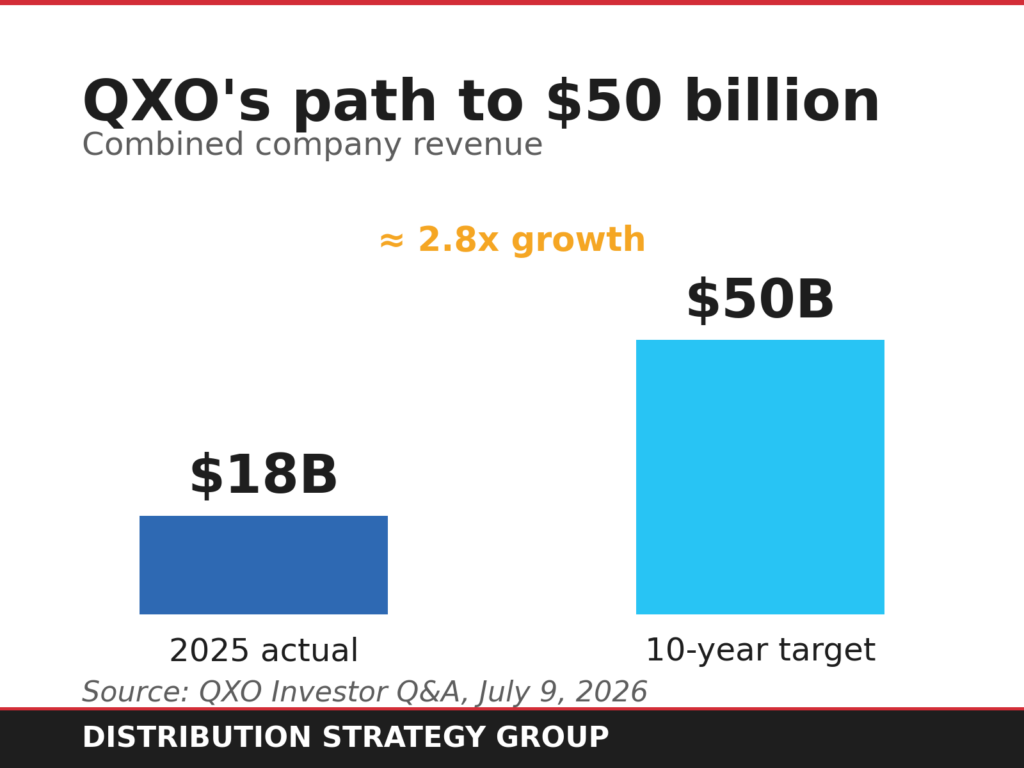
Looking ahead, the company reiterated its long-term financial targets, including more than doubling adjusted EBITDA by 2030 through operational improvements and expanding annual revenue to $50 billion within the next decade through organic growth and targeted acquisitions. Management said those goals will be driven primarily by execution rather than another wave of large acquisitions or a broad recovery in construction markets.
Do not miss any content from Distribution Strategy Group. Join our list.
Share this article:
