



Why This Matters to Distributors: The combination would create a $12.5 billion chemicals supplier with about 14,000 employees and operations spanning major industrial markets. Huntsman also sells through a global network of distributors and agents, making the integration of the two companies’ product portfolios, supply chains and sales channels relevant to chemical distributors and their customers.
Olin Corp. and Huntsman Corp.’s shareholders have approved the companies’ proposed all-stock merger, clearing a major hurdle toward combining two global chemical suppliers with $12.5 billion in annual revenue.
About 97% of votes cast by Olin shareholders supported the transaction at a special meeting Aug. 25, representing 81% of the company’s outstanding shares. About 99% of votes cast by Huntsman shareholders approved the deal, representing 75% of its outstanding shares, according to preliminary voting results.
The transaction is expected to close in the first half of 2027, subject to regulatory approvals and other closing conditions.
The companies announced the merger June 16. Under the agreement, each Huntsman share will be converted into 0.5476 shares of Olin stock. Olin shareholders are expected to own about 54.5% of the combined company, with Huntsman shareholders owning about 45.5%.
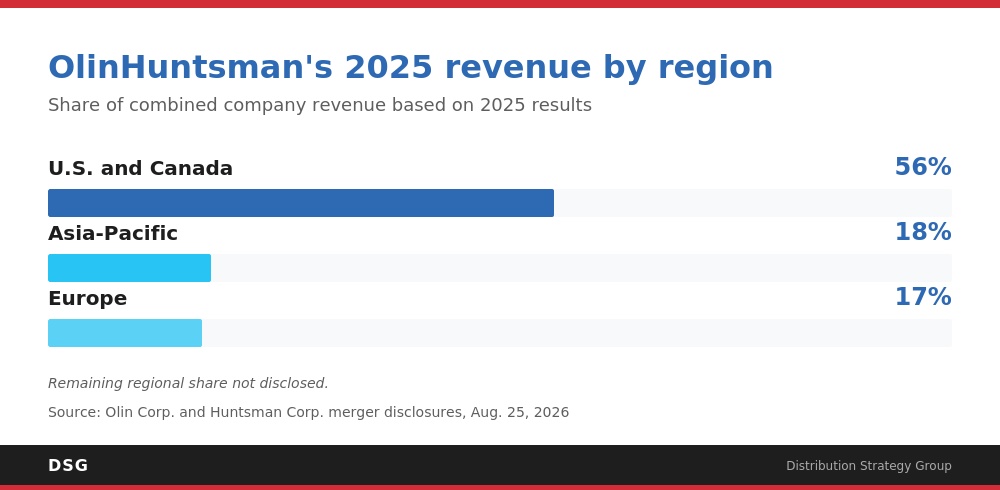
The combined company, OlinHuntsman Corp., would have approximately 14,000 employees and serve customers across aerospace, automotive, construction and infrastructure, electronics, energy, industrial, water treatment and other markets. Based on 2025 results, about 56% of its revenue would come from the U.S. and Canada, 18% from Asia-Pacific and 17% from Europe.
The merger would also connect Olin’s upstream chemical manufacturing operations more directly with Huntsman’s downstream products and customer base.
Olin manufactures and distributes chlorine and caustic soda, vinyls, epoxies, chlorinated organics, bleach, hydrogen and hydrochloric acid. Huntsman produces polyurethane products, amines and advanced materials used across industrial and manufacturing markets.
Huntsman sells approximately 200 products to more than 800 customers globally and supplements its direct sales organization with an extensive network of distributors and agents. Those channel partners primarily serve smaller customers that Huntsman says cannot be served as cost-effectively through its direct sales force.
That distribution network could become a broader route to market for the combined company as Olin and Huntsman integrate their operations, although the companies have not announced specific changes to distributor agreements, territories or channel strategies.
Olin and Huntsman already have a supplier relationship. Company filings show that executives had discussed strengthening their commercial supply arrangements before merger talks began. Olin currently supplies major feedstocks used by Huntsman’s three business divisions.
The companies expect the combination to generate more than $400 million in annual cost savings and other integration benefits. About $75 million is expected to come from purchasing and raw-material integration, including procurement scale, supply-chain efficiencies and logistics changes.
Part of that plan involves shifting some Huntsman raw-material requirements from outside suppliers to Olin. The companies said Olin could internally supply ethylene dichloride and caustic soda to Huntsman’s amines business and epichlorohydrin and liquid epoxy resin to its advanced materials operations.
Those changes could reduce purchases from some outside suppliers as the combined company moves more material through its own manufacturing network.
Olin CEO Ken Lane will serve as CEO of OlinHuntsman. Huntsman Chairman and CEO Peter Huntsman will become nonexecutive chairman.
“We are committed to completing the remaining steps to close the transaction,” Lane said following the shareholder votes.
Huntsman said the combination would expand what the companies can provide customers.
“OlinHuntsman will be better positioned to compete in an increasingly global industry, delivering value, adding products and greater service for customers,” Huntsman said.
The companies have not announced changes to their existing distributor networks. Until the transaction closes, Olin and Huntsman will continue operating as separate companies.
Do not miss any content from Distribution Strategy Group. Join our list.
Share this article:
