



Why This Matters to Distributors: BlueLinx is showing how building products distributors can grow in a weak housing market. Rather than waiting for residential construction to recover, the company is gaining market share through specialty products, strategic supplier partnerships, digital transformation, and disciplined operational execution.
BlueLinx Holdings reported higher second-quarter sales and profits as investments in specialty products, supplier partnerships and digital transformation helped the building products distributor outperform a sluggish housing market.
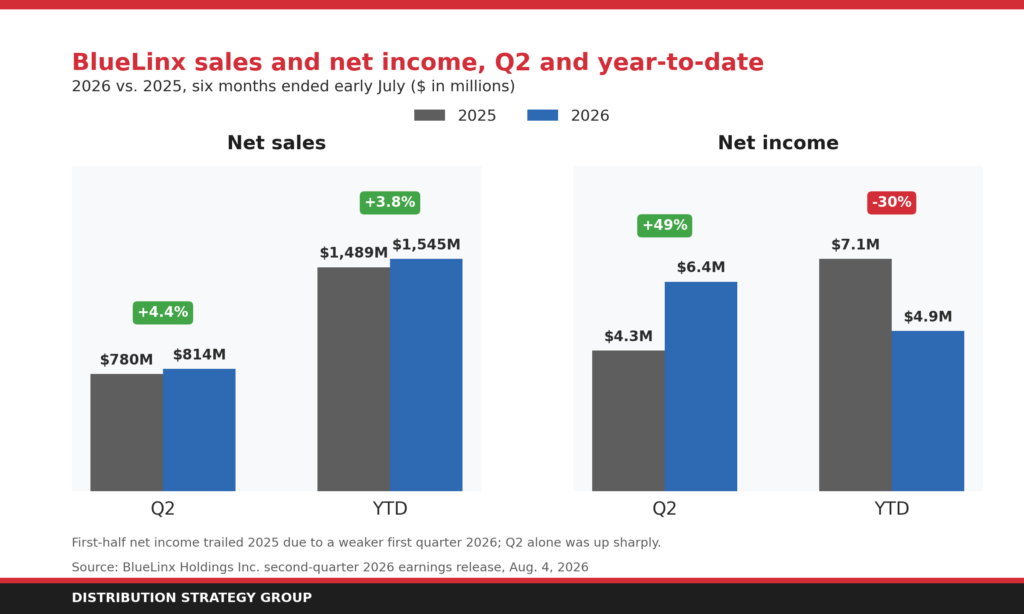
The Atlanta-based company posted second-quarter sales of $814.1 million, up 4.4% from $780.1 million a year earlier. Net income increased 48.6% to $6.4 million from $4.3 million, while gross profit rose 16.7% to $139.7 million from $119.7 million. Gross margin improved to 17.2% from 15.3%, although results included a $7.2 million import duty-related benefit. Excluding that item, gross margin was 16.3%, up from 15.3% a year earlier.
For the first six months of 2026, sales increased 3.8% to $1.55 billion from $1.49 billion in the same period last year. Gross profit rose 11.0% to $256.1 million from $230.8 million, while gross margin improved to 16.6% from 15.5%. Net income declined to $4.9 million from $7.1 million, primarily because of higher interest expense.
“Our second quarter results once again demonstrate our ability to deliver profitable sales growth in a challenging market environment, validating the strength of our channel and product strategies,” President and CEO Shyam Reddy told analysts. “We believe our results reflect market share gains since we’re operating in another year of single-family and multifamily housing start declines and tepid repair-and-remodel activity.”
BlueLinx’s strategy centers on expanding its higher-margin specialty products business while reducing its dependence on more volatile commodity building materials.
Specialty product sales increased 3.8% to $564.1 million during the quarter, supported by the acquisition of Disdero Lumber, higher pricing and stronger demand for engineered wood and industrial products. Gross margin for the segment improved to 20.0% from 18.5%.
Structural product sales rose 5.6% to $249.9 million, driven by stronger lumber pricing and higher shipment volumes. Gross margin improved to 10.9% from 8.2%.
Reddy said specialty products now account for approximately 70% of BlueLinx’s sales and 80% of its gross profit, underscoring the company’s long-term shift toward higher-value product categories.
“Our channel strategy continues to fuel our branded specialty product expansion, both geographically and SKU-wise with strategic suppliers,” he said.
BlueLinx said strategic partnerships with manufacturers are becoming a key competitive advantage.
The company expanded relationships during the quarter with suppliers including Huber, Louisiana-Pacific, Georgia-Pacific, Westlake Royal Building Products and RDI. It also announced a new distribution agreement with Trex that gives BlueLinx rights to distribute the decking manufacturer’s products across 11 markets in the central, northern, and southern United States.
“The virtuous cycle is leading to stickier relationships with both customers and suppliers,” Reddy said. “Suppliers want partners who can help them grow across multiple channels and markets. That’s what we’re doing.”
Reddy said the Trex agreement reflects BlueLinx’s growing ability to help manufacturers expand into new markets.
“We are a brand-new distribution partner for Trex,” he said. “I believe in our team’s ability to execute to the point where we’re able to convince not only our long-term partners, but our new partners, that we are the best commercialization partner out there.”
He said Trex is expected to become a more meaningful contributor beginning in 2027 as BlueLinx ramps up inventory and expands customer adoption.
Executives said BlueLinx continues to outperform the broader building products market by focusing on multifamily housing, national accounts, and builder pull-through programs.
Multifamily volumes increased 11% during the quarter, while national account volumes rose 2% despite continued weakness in residential construction. The company also expanded distribution of key product lines into additional markets.
“Whether the market is great or terrible, I’m confident that our teams can continue getting more and more of the pie because of the strategic approach we’re taking,” Reddy said. “We are focused on winning at the local market and regional levels and continuing to gain share.”
BlueLinx also credited investments in artificial intelligence and digital technologies with improving pricing, inventory management, transportation, and e-commerce.
“We are making meaningful progress on our AI and digital transformation initiatives,” Reddy said. “Several are designed to enhance commercial activities, fine-tune our inventory management capabilities and generate e-commerce sales.”
Chief Financial Officer Kelly Wall said new pricing tools and transportation management systems are helping offset higher operating costs while improving execution.
“Our pricing initiatives, through the use of data and better tools, are helping our regions and branches price more effectively and more quickly,” Wall said. “Our transportation management system is helping us manage freight costs in a significantly higher fuel and third-party freight cost environment.”
BlueLinx also improved cash generation by tightening inventory management and controlling working capital.
Operating cash flow improved to $11.2 million, compared with a use of $26.8 million in the second quarter of 2025. Free cash flow improved by $45 million to $8.8 million, while the company ended the quarter with $318 million in cash and $655 million in available liquidity.
“Our ability to quickly align inventory levels with changing market conditions reflects the strength of our operating discipline and commercial capabilities,” Reddy said. “As market conditions improve, we expect these capabilities to support even stronger cash flow generation.”
BlueLinx expects average daily sales volumes in the third quarter to exceed both the prior-year period and the second quarter, supported by continued market-share gains, expanding supplier relationships and growth in specialty products. The company forecast specialty product gross margins of 18% to 19% and structural product gross margins of 8.5% to 9.5%.
“Overall, our second quarter results reflect continued momentum and solid financial performance despite low consumer confidence, persistent inflation, economic uncertainty and geopolitical volatility,” Reddy said. “We remain focused on executing through the cycle and positioning BlueLinx for accelerated growth when the industry recovers.”
Do not miss any content from Distribution Strategy Group. Join our list.
Share this article:
