



Why This Matters to Distributors: Consolidation in fuel distribution is accelerating as larger operators expand scale, technology capabilities, and supply chain reach. For independent distributors, rising valuations and active buyer demand may create a narrowing window for ownership transition opportunities.
Merger and acquisition activity in the fuel distribution sector accelerated in early 2026 as favorable tax policy, growing competitive pressure and succession planning among privately held operators combined to drive dealmaking higher, according to a new report from Capstone Partners.
Capstone said 22 fuel distribution transactions were announced or completed through April, up 29.4% from the same period a year earlier. While full-year 2025 deal activity increased only modestly, momentum has strengthened entering 2026 as strategic buyers and private equity firms continue pursuing acquisitions across propane, commercial fuels, and petroleum distribution.
“Distribution of propane and refined products is a critical component to the energy infrastructure continuum,” Ren Nebel, managing director at Capstone Partners, said in the report. “Capital formation around fuel distribution remains strong as investors seek stable cash-flow characteristics, diversified end market exposure, essential use demand, and a resilient credit profile across market cycles.”
Strategic buyers accounted for 68.2% of transactions year to date, with many acquisitions focused on expanding geographic reach and strengthening regional operations. Private equity firms represented 31.8% of deals, up from 17.6% a year earlier, with most activity centered on add-on acquisitions rather than new platform investments.
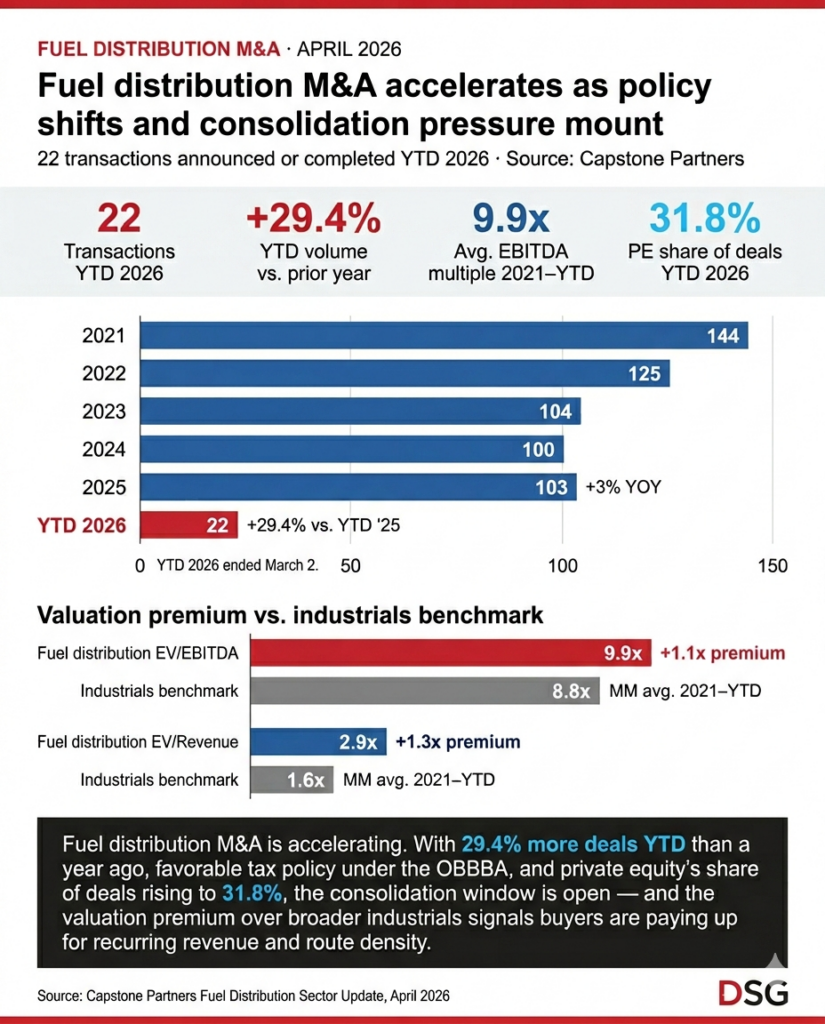
Capstone said fuel distribution companies continue to command higher valuations than broader industrial businesses because of recurring revenue, long-term customer relationships, and operational scale.
The report also cited federal policy changes as a catalyst for increased acquisition activity. Legislation enacted in 2025 restored 100% bonus depreciation for qualified assets acquired during the year of purchase, improving acquisition economics for buyers. Additional federal energy policy changes, including the rollback of electric vehicle incentives and lower fuel economy standards, have reinforced near-term demand expectations for traditional fuel distributors, according to the report.
Commodity markets also remain volatile. West Texas Intermediate crude reached $112.30 per barrel in April amid OPEC production cuts and geopolitical tensions near the Strait of Hormuz, while propane prices edged higher alongside stronger natural gas liquids demand.
Among the sector’s largest transactions, Sunoco completed its acquisition of Parkland in May 2025 in a deal valued at $10.1 billion. The acquisition created a combined company distributing more than 15 billion gallons of fuel annually across the Americas.
Private equity-backed consolidation also accelerated in propane distribution. Revelar Capital acquired Lettermen’s Energy in December 2025, while Trive Capital acquired Rolfson Oil and later added Flint Logistics Group to expand operations across major U.S. shale regions.
Meanwhile, RelaDyne completed its 14th acquisition since late 2021 with the purchase of Dion & Sons, extending its presence in Southern California.
Capstone said industry fragmentation continues to fuel consolidation as larger operators invest in logistics, loyalty programs, technology integration, and supply chain efficiency that smaller operators often struggle to match. For distributors operating multiple business segments, the report said divesting non-core operations has become an increasingly common strategy to focus capital on higher-growth areas.
Among public companies, Suburban Propane Partners reported spending about $53 million on acquisitions during fiscal 2025, while Star Group reported higher revenue and earnings tied partly to acquisitions and colder weather demand.
Do not miss any content from Distribution Strategy Group. Join our list.
Share this article:
