


Why This Matters to Distributors: Sustainability reporting is rapidly becoming a competitive requirement across wholesale distribution. Large customers, institutional investors, and public-sector buyers increasingly expect suppliers to provide measurable environmental, workforce and governance data. As reporting standards become more rigorous, distributors without formal ESG programs may face growing challenges in customer acquisition, supplier relationships, and access to capital.
Two of North America’s largest wholesale distributors have released sustainability reports in 2026, providing the industry’s first detailed look at environmental, social and governance performance for fiscal year 2025 and offering an early indication of where distributor sustainability priorities are shifting.
Wesco International and US Foods are the first major distributors to publish reports this year, detailing progress on emissions reductions, workplace safety, workforce development, and sustainable supply chain initiatives. Both companies continue to align their disclosures with globally recognized reporting frameworks and include quantitative performance measures that increasingly are becoming standard among large public distributors.
The reports arrive as sustainability reporting continues to evolve from a corporate communications exercise into a business requirement shaped by customer procurement expectations, investor scrutiny, and emerging regulatory disclosure standards.
Wesco, the Pittsburgh-based distributor of electrical, communications, utility and broadband products, used its 2026 Sustainability Report to update progress against a series of environmental, social and governance goals established in 2021 and targeted for completion by 2030.
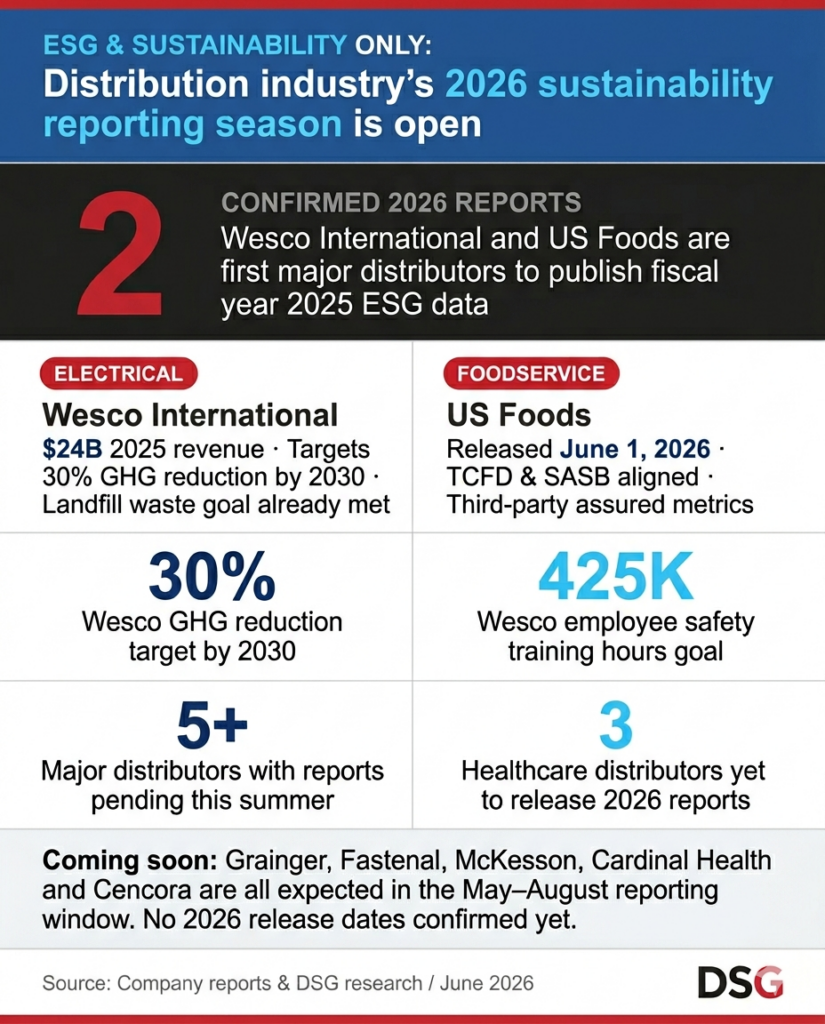
Among those goals are a 30% reduction in Scope 1 and Scope 2 greenhouse gas emissions, a 15% reduction in landfill waste intensity, a 15% improvement in total recordable incident rates and the completion of 425,000 cumulative employee safety-training hours.
The company reported that it has already achieved its landfill waste-intensity reduction target and remains on track toward its workforce safety objectives. Wesco also highlighted ongoing investments in employee training, community engagement, and responsible sourcing programs across its global operations.
With approximately $24 billion in 2025 revenue, Wesco remains one of the largest distribution companies in North America. Its sustainability priorities are particularly relevant because of its exposure to utility infrastructure, electrical construction, communications networks, and industrial markets where customers increasingly require suppliers to document emissions, safety performance, and supply-chain practices.
US Foods, the Rosemont, Illinois-based foodservice distributor, released its 2025 Sustainability Report on June 1, making it one of the first major distributors in the foodservice sector to publicly disclose fiscal-year 2025 sustainability data.
The report is organized around three strategic pillars: Products, People and Planet.
Under Products, US Foods highlighted growth in its sustainable and responsibly sourced private-brand offerings. Under People, the company detailed workforce development, employee engagement, and community investment initiatives. Under Planet, the report focused on transportation efficiency, fleet modernization, facility energy management, and efforts to reduce environmental impacts throughout its operations.
“Being a responsible company is integral to our strategy, underpinning how we grow our business, strengthen customer relationships, maximize associate engagement and productivity, and contribute to a better planet,” Chairman and CEO Dave Flitman said in the report.
US Foods continues to align its disclosures with the Task Force on Climate-related Financial Disclosures and Sustainability Accounting Standards Board frameworks for food retailers and distributors. The company also uses independent third-party assurance for selected sustainability metrics, a practice that has become increasingly common among large public companies seeking to enhance the credibility of their disclosures.
The reports from Wesco and US Foods provide an early indication of how sustainability reporting within wholesale distribution is maturing.
Five years ago, many distributor sustainability reports focused primarily on narrative descriptions of charitable giving, employee volunteerism, and broad environmental commitments. Today’s reports increasingly resemble operational scorecards, incorporating emissions inventories, safety metrics, workforce demographics, governance structures, and measurable progress against long-term targets.
That evolution is being driven by changing customer expectations.
Many large manufacturers, utilities, healthcare organizations, government agencies, and enterprise customers now include sustainability criteria in supplier qualification and procurement processes. Publicly traded distributors also face growing pressure from institutional investors to disclose climate-related risks, workforce practices and governance policies using consistent reporting standards.
The trend is particularly pronounced among larger distributors serving Fortune 500 customers, where procurement teams increasingly request emissions data, supplier diversity information, workplace safety performance, and evidence of sustainability governance programs as part of contract negotiations.
Several major distributors have yet to release 2026 sustainability reports.
W.W. Grainger’s most recent sustainability disclosure covered fiscal-year 2024 performance and was published in July 2025. Fastenal released its most recent ESG report in July 2025, covering calendar-year 2024 results. Updated reports from both companies are expected later this summer.
Healthcare distribution leaders McKesson, Cardinal Health and Cencora also maintain annual sustainability reporting programs but have not yet announced release dates for their 2026 reports.
As additional reports are released over the coming months, distributors will gain a clearer picture of how peers are addressing emissions reductions, workforce development, supply-chain transparency, and governance accountability. The reports are also likely to reveal which companies are moving beyond compliance and using sustainability initiatives as a competitive tool in customer acquisition and retention.
The broader message from the opening weeks of the 2026 reporting cycle is clear: sustainability reporting has become a permanent part of the wholesale distribution landscape. For many distributors, the question is no longer whether to report, but how comprehensive and measurable those disclosures need to be to meet the expectations of customers, investors, and other stakeholders.
Do not miss any content from Distribution Strategy Group. Join our list.
Share this article:
