



Why This Matters to Distributors: Lowe’s is leaning harder into professional customers as its acquisitions of Foundation Building Materials and Artisan Design Group expand its reach into specialty distribution. Second-quarter sales increased 8.3%, even as comparable sales rose just 0.2% and DIY demand remained under pressure.
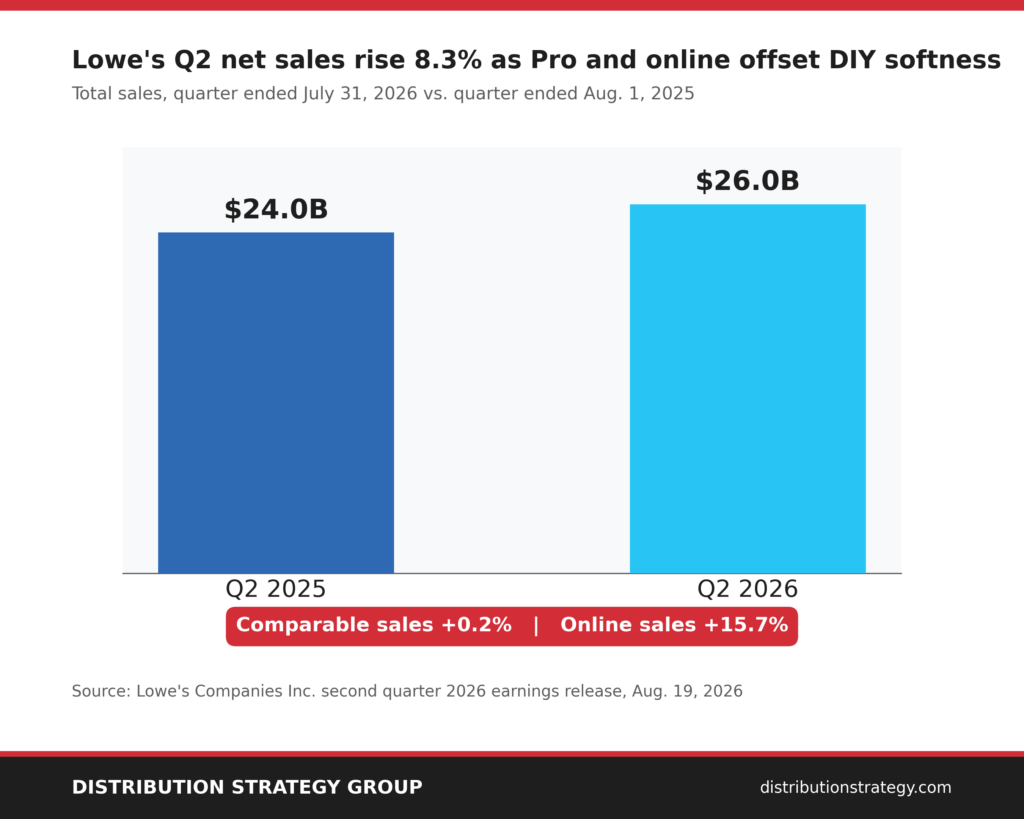
Lowe’s Cos. reported an 8.3% increase in second-quarter sales, with growth from professional customers, ecommerce and home services helping offset continued weakness in discretionary do-it-yourself spending.
Sales increased to $25.96 billion for the quarter ended July 31 from $23.96 billion a year earlier. Net earnings were unchanged at $2.40 billion. Comparable sales increased 0.2%.
For the first six months of the year, sales increased 9.2% to $49.03 billion from $44.89 billion. Net earnings declined 0.3% to $4.03 billion from $4.04 billion.
The results show Lowe’s increasingly relying on its Pro business and acquisitions for growth as demand from its traditional DIY customers remains soft.
Lowe’s said strong Pro and home services sales helped drive comparable sales during the quarter. Online sales increased 15.7%, while what the company described as persistent macroeconomic pressure on DIY customers weighed on results.
“Sustained growth in Pro, Online and Home Services led to our fifth consecutive quarter of positive comp sales, despite pressure in discretionary DIY spending,” Chairman, President and CEO Marvin Ellison said.
The Pro business has become a larger part of Lowe’s strategy as the company expands beyond its traditional home improvement stores and deeper into specialty distribution.
Its acquisitions of Foundation Building Materials and Artisan Design Group significantly broadened Lowe’s reach with professional contractors. The deals added specialized distribution operations and hundreds of branches to a network historically centered on big-box retail stores.
Lowe’s recorded $96 million in pretax expenses during the second quarter related to the Foundation Building Materials and Artisan Design Group acquisitions. Excluding those costs, adjusted diluted earnings per share increased 1.6% to $4.40.
The acquisitions have also changed the scale and structure of Lowe’s operations. The company now operates more than 1,750 home improvement stores, 540 branches and 120 distribution centers and employs about 300,000 people.
That expanded branch network gives Lowe’s another route to professional customers beyond its stores and ecommerce operations, putting the company in more direct competition with specialty building products distributors.
The company’s balance sheet reflects the size of that expansion. Intangible assets increased to $5.71 billion as of July 31 from $976 million a year earlier, while goodwill rose to $3.96 billion from $691 million.
Despite the second-quarter sales increase, Lowe’s lowered its expectations for the full year as demand remains uneven.
The company now expects 2026 sales of about $92 billion, narrowing its previous forecast of $92 billion to $94 billion to the bottom of that range. Lowe’s expects comparable sales to be flat compared with 2025, down from its previous forecast of flat to 2% growth.
Lowe’s also expects diluted earnings per share of about $11.75, compared with its previous range of $11.75 to $12.25. The company continues to plan capital spending of up to $2.5 billion.
The revised outlook underscores the split developing within Lowe’s business: discretionary DIY demand remains under pressure, while Pro, ecommerce and home services continue to grow.
For distributors, the more consequential development is Lowe’s expansion deeper into the professional supply chain. Foundation Building Materials and Artisan Design Group give the company a larger branch network, specialized products, and additional access to contractors outside its traditional stores.
With Pro sales again helping drive second-quarter performance, Lowe’s is increasingly competing not just as a home improvement retailer, but as a large-scale supplier to professional contractors, raising the competitive stakes for building products distributors serving the same customers.
Do not miss any content from Distribution Strategy Group. Join our list.
Share this article:
