



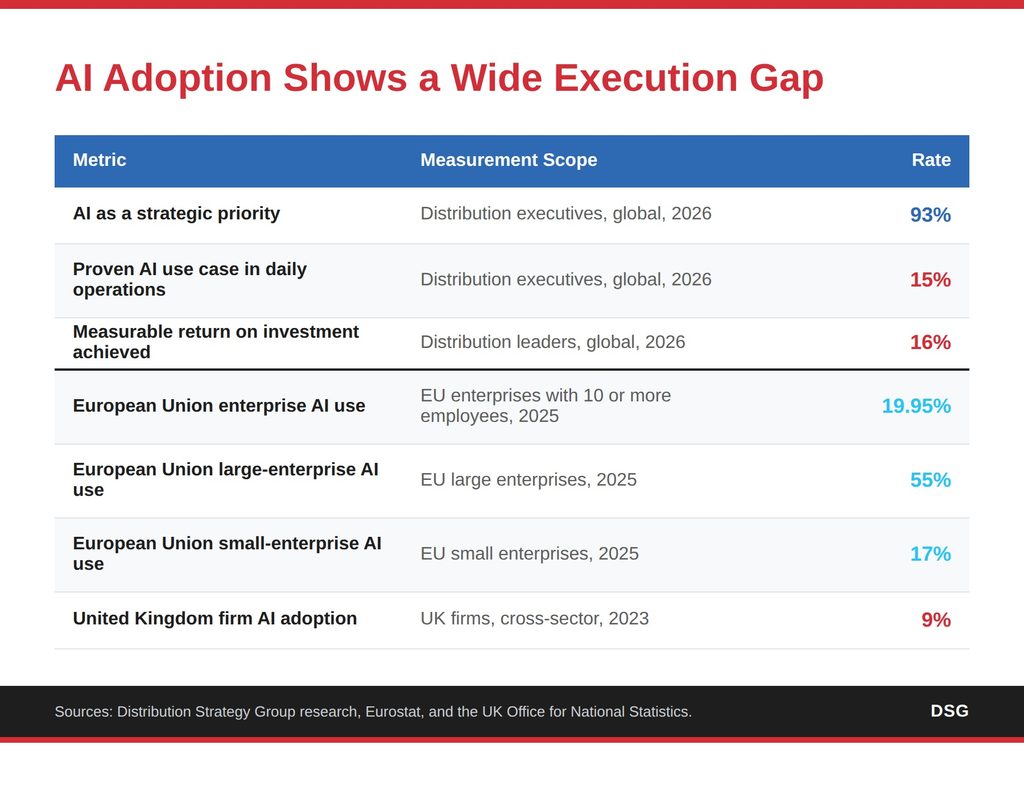
You already believe in artificial intelligence. According to 2026 Distribution Strategy Group (DSG) research, 93% of wholesale distribution executives call AI a strategic priority. But only 15% of distributors have moved a proven use case into daily operations.
That is the gap that matters.
The question is no longer whether AI matters. It is whether you can put it to work in the business. The wholesalers and merchants doing that are beginning to build an operating advantage over those still evaluating the technology.
According to 2025 Boston Consulting Group (BCG) research, companies that systematically embed AI into their operating models can achieve up to five times the revenue gains and three times the cost reductions of laggards. That advantage compounds as leaders lower their cost to serve, improve margins, and put more use cases into production.
The problem is increasingly less about technology than the discipline required to deploy it. Wholesalers that scale AI treat it as an operating discipline owned by the business. Those stuck in permanent pilots too often treat it primarily as an information technology project.
The Execution Gap
The broader numbers show the problem. Recent 2026 reporting indicates 88% of AI pilots never reach production or scale. For generative AI specifically, a 2026 Massachusetts Institute of Technology Media Lab report puts the failure-to-return-on-investment rate at 95%.
That is not necessarily an argument for waiting until the tools improve. It is an argument for fixing the process that turns a working pilot into a daily operation.
The early movers are already visible. DSG research on more than 300 North American distributors found only 26 that met the bar for integrated, production-level AI capability. Grainger, Wesco, Sonepar and Rexel are among the companies that have moved beyond asking where AI fits and are building it into their operating models.
For European wholesalers and merchants, Sonepar and Rexel make the point particularly relevant. This is not simply a North American trend.
European adoption data also shows a significant gap in company size. Eurostat reports that about 20% of European Union enterprises used AI in 2025. Among large enterprises, adoption was 55%, compared with 17% among small enterprises. The larger players are moving faster.
DSG’s State of AI in Distribution research shows a similar divide between individual use and operational deployment. Some 63% of distributors surveyed use ChatGPT, but only 15% have put a proven AI use case into daily operations.
The first number represents people using an AI tool. The second represents companies changing how they operate.
That is the execution gap.
The money is already showing up for companies that moved first. Rexel reported digital sales at 34% of group sales in 2025 and 35% for the first six months of 2026. In Europe, digital represented 44% of Rexel’s sales in 2025, supported by the adoption of digital tools and algorithmic quote and order entry.
That is a European wholesaler building an operating advantage that becomes harder for competitors to close the longer they wait.
Put the Business in Charge
One of the biggest barriers to closing the execution gap is treating AI primarily as an information technology project.
The reflex with new software is often to hand it to the information technology department. But AI changes how work happens at the branch counter, how salespeople negotiate, how buyers procure and how customer service teams process orders.
An information technology leader knows how to connect an application programming interface (API). That person may not have the operating context to redesign the quoting workflow for counter staff.
Without a clear process owner, an accountable executive sponsor and cross-functional involvement, pilots struggle to move into production. The wholesalers and merchants that scale AI put business leaders in charge of business outcomes.
Grainger’s differential investment model assigns high-stakes projects to leaders pulled from operations, people who understand the profit drivers and own the outcome. Sysco elevated its AI strategy to board-level oversight in 2026 and tied it to a $100 million cost-savings target.
The lesson is straightforward: Put accountability with leaders who own the process, the customer, and the financial result.
Start Where the Value Is Obvious
Getting started does not require a companywide transformation program. It means aiming AI at one high-volume, rules-based bottleneck and getting a measurable result inside a quarter.
Several workflows stand out.
Demand forecasting and the bullwhip effect. Wholesale distribution sits in the middle of the supply chain, making it particularly exposed to the bullwhip effect, where relatively small changes in customer demand can create much larger stock swings upstream.
Traditional forecasting models lean heavily on historical sales and moving averages. A retailer batches an order to capture a freight discount, or a manufacturer runs a promotion, and older models can interpret those artificial spikes as changes in underlying demand.
Machine learning models can incorporate point-of-sale information, weather, and economic indicators to identify anomalies and produce a cleaner purchasing baseline. Wholesalers using algorithmic demand sensing report 40% to 50% lower forecast errors, potentially reducing excess stock while improving fill rates.
Start here if working capital is tied up in the wrong stock.
Order entry and margin recovery. Order entry remains one of the back-office functions that can quietly limit revenue capacity. A business-to-business (B2B) wholesaler processing thousands of orders each month through email, PDF files and spreadsheets can still depend heavily on manual keying into an enterprise resource planning (ERP) system.
AI-based order entry can extract line items, map customer part numbers to an item master, validate contract pricing and draft the sales order. Exceptions can be routed to an employee rather than requiring every line to be processed manually.
DSG research puts productivity improvement from automating quote generation at 40% to 70%. Rexel Canada, for example, deployed agentic document processing with Onit and Hyland and achieved near-perfect invoice indexing accuracy within 48 hours in 2026.
Start here if customer service teams are spending too much time on manual order entry.
Pricing and getting salespeople to hold the line. In a high-volume, low-margin business, small improvements in price realization can have an outsized effect on operating profit.
Pricing ranks as the No. 1 AI priority for 27% of distributors surveyed by DSG in 2026. AI pricing engines can analyze customer price sensitivity, purchase frequency, order volume, and competitive position to generate recommendations at the quote level.
But generating the right price is only half the job. The salesperson must use it.
A 2025 study involving a B2B aluminum retailer found that machine learning price recommendations increased profit on treated quotes by 11%. If salespeople routinely override recommendations, however, the technology cannot deliver the intended result.
Start here if margin is leaking through discretionary discounting.
Accounts receivable and cash velocity. Invoice-to-cash has traditionally depended on labor-intensive matching of remittances to open invoices. Accounts receivable automation can issue invoices, ingest payment information, match payments and route disputes based on defined rules.
The models can learn customer remittance patterns and match payments even when reference numbers are missing or a customer short pays.
Start here if days sales outstanding is a constraint.
The Demand Side Is Moving Too
AI readiness is becoming a two-sided issue. Wholesalers and merchants need AI internally to operate more efficiently, but they also need their product and transaction data to be accessible to the AI systems their customers increasingly will use.
Agentic commerce means software acting for a buyer to search catalogs, verify pricing, confirm availability, and potentially execute transactions. B2B procurement, with its repeat purchases, technical specifications and negotiated contracts, is a natural environment for that technology.
DSG’s AI 2030 framework found 61% of organizations expect to deploy fully autonomous AI agents for complex functions within five years.
That changes the importance of product data.
An AI purchasing agent does not need to browse a homepage. It can query structured product information directly. Wholesalers therefore need clean, machine-readable catalogs containing accurate technical attributes, Global Trade Item Numbers (GTINs), and appropriate product classifications.
That also increases the importance of secure APIs that can expose appropriate contract pricing and real-time stock information to authorized systems.
The work required to support machine buyers is another reason to begin addressing product data now rather than waiting for agentic commerce to mature.
Get the Foundation Right Without Waiting
Data is one of the most common reasons companies delay AI deployments, but waiting for perfect data can become its own barrier.
No model will automatically reconcile a duplicated customer master or inconsistent item records. Some wholesalers freeze deployments while waiting for pristine data. Others run algorithms against fragmented ERP information and get confident but incorrect answers.
The better approach is to improve the data required for a specific use case while that use case is being developed.
The European Technical Information Model (ETIM), used across European and North American electrical and heating, ventilation and air conditioning markets, provides a shared product classification structure. In UK building materials, the Builders Merchants Federation (BMF) Product Data Template serves a similar purpose and feeds into Data Yard, the industry data pool developed by the BMF with the National Merchant Buying Society.
Master data cleanup is not something to skip. But it does not have to be completed across the entire business before the first AI deployment begins.
Build Governance in From the Start
European wholesalers also have a regulatory consideration their North American counterparts do not face to the same degree.
The European Union AI Act, in force since August 2024, establishes a risk-based approach to AI governance and can apply to companies outside Europe when their systems affect people in the European Union.
For wholesalers and merchants, some of the clearest requirements involve employment applications such as automated curriculum vitae screening, task allocation, performance evaluation, and workforce monitoring. These can fall into high-risk categories requiring governance, documentation, and human oversight.
AI systems affecting pricing or credit also require careful governance because of potential discrimination risks.
That is not a reason to delay deployment. It is a reason to build governance into the first use case rather than bolt it on later.
What Changes Monday Morning
Moving from evaluation to an operational deployment requires three decisions from the executive team.
Put a business leader in charge. Take AI strategy out of the exclusive control of information technology. Give a senior business leader with profit-and-loss responsibility ownership of the outcomes. Review what workflows changed, what financial return was generated and what process comes next.
Pick one hard bottleneck and commit to a 90-day result. Stop broad, undefined experiments. Pick a specific constraint, such as margin erosion or manual entry of emailed purchase orders, and apply a specialized tool to it. Establish one or two key performance indicators (KPIs) at the start so the business can determine within a quarter whether the deployment worked.
Start the data work in parallel. Do not wait for perfect data. Clean and standardize the information required for the first use case while building the capability to support the next one.
The objective is not to build an AI strategy on paper. It is to put one use case into daily operations, measure the result and use what the organization learns to tackle the next process.
The Two-Quarter Window
The window to treat AI solely as a future capability has closed. The opportunity now is to move it into daily operations.
The wholesalers and merchants building an advantage are not necessarily doing so because they have access to better AI. They are getting better at selecting specific business problems, putting operating leaders in charge, and turning successful pilots into repeatable processes.
The next two quarters provide enough time to do something tangible: Choose a bottleneck, establish ownership, put a use case into production, and measure the result.
Theory does not move market share. Execution does.
AI Forum UK & Europe, Oct. 15, 2026, at the National Conference Centre in Birmingham, will bring together wholesale distribution and merchant leaders to examine AI deployments, implementation costs, timelines, data preparation, and the lessons emerging from putting AI into day-to-day operations.
Register for AI Forum UK & Europe
Where European wholesale distribution leaders turn AI into competitive advantage.
Share this article: