



Why This Matters to Distributors: HARDI’s first state-by-state economic analysis of HVACR wholesale distribution puts numbers behind the industry’s economic and employment footprint, while also highlighting an ongoing challenge: distributors need to hire and train more than 18,000 workers annually just to maintain current staffing levels.
Heating, Air-conditioning & Refrigeration Distributors International estimates that HVACR wholesale distribution generates $32.9 billion in annual economic output and directly supports 101,817 jobs across the U.S., according to the trade association’s first state-by-state analysis of the industry.
The study, “Keeping America Comfortable: A Baseline Economic Impact Analysis of HVACR Wholesale Distribution Across All 50 States,” estimates that the industry contributes $17.8 billion in economic value and provides $8.7 billion in employee compensation, including $7.6 billion in wages and salaries. Average compensation is about $86,000 per direct job.
The report also identified a significant workforce challenge. HARDI estimates HVACR distributors must hire and train about 18,268 workers annually (1,522 each month) simply to maintain current employment levels because of employee turnover.
Operations and warehouse employees account for 65.1% of the industry’s workforce and have an annual turnover rate of 22.4%, according to HARDI. Those positions take an average of 34 days to fill. Across the industry’s workforce, HARDI calculated a 17.9% turnover rate.
Recruiting also remains a concern for distributors. HARDI’s compensation and benefits research found 44.7% of distributors identified finding qualified employees as a top business concern, ranking ahead of health care costs, and rising operating expenses.
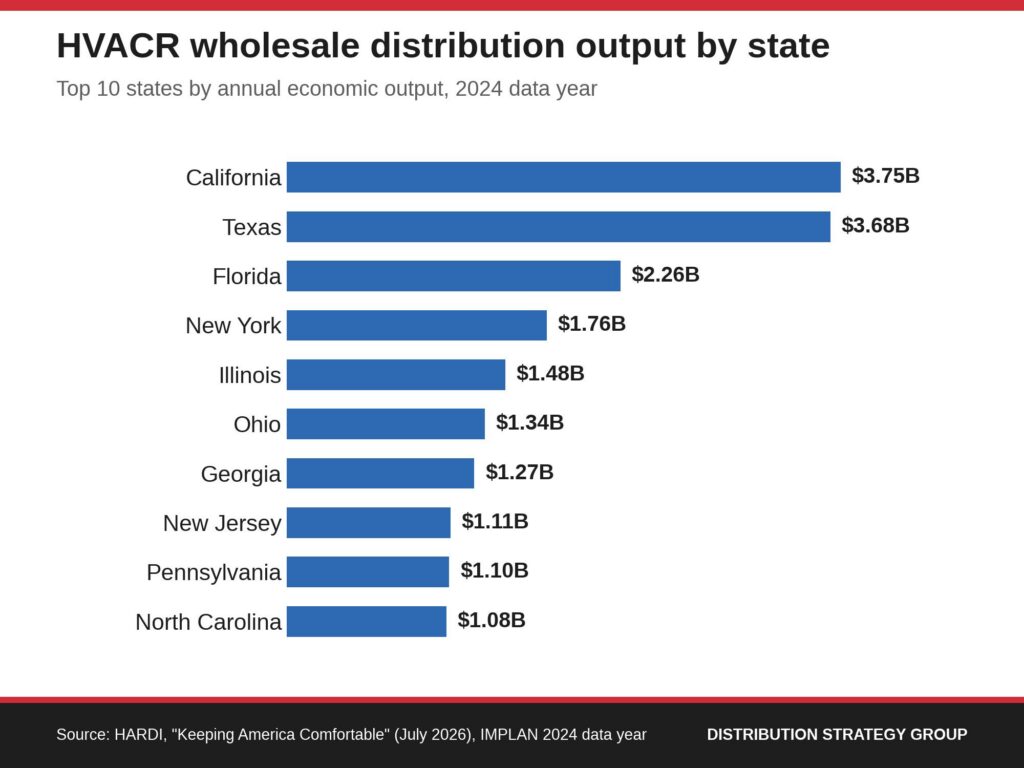
Texas has the largest HVACR distribution workforce, with 14,864 direct jobs, followed by Florida with 9,115 and California with 7,276. California, however, leads the country in economic output at $3.75 billion.
The 10 largest states by economic output (California, Texas, Florida, New York, Illinois, Ohio, Georgia, New Jersey, Pennsylvania, and North Carolina) account for 57% of the industry’s total output.
HARDI developed the estimates using IMPLAN economic modeling, the U.S. Census Bureau’s 2022 Economic Census and employment data from the Bureau of Labor Statistics’ Quarterly Census of Employment and Wages. The analysis was designed to separate HVACR distribution from the broader durable goods wholesale sector, where it is grouped with industries including construction materials, metals, and furniture distribution.
That distinction produced a notable difference in employment estimates. An initial economic model estimated 85,218 HVACR distribution jobs, but employment data reported directly by states produced an estimate of 101,488 jobs—about 19% higher. HARDI attributed the difference to HVACR distribution requiring more workers for each dollar of sales than the broader wholesale category used in the economic model.
HARDI said the study establishes a baseline that can be updated as new Census Bureau, labor and economic data become available. The association plans to use the state-level findings in workforce planning and discussions with policymakers.
The findings also give HVACR distributors more specific data on the size of their industry at a time when labor availability remains a significant operating issue. The study shows that maintaining the industry’s existing workforce alone requires distributors to replace one in five workers each year.
Do not miss any content from Distribution Strategy Group. Join our list.
Share this article:
