
Hiring the right salespeople is the first step of great onboarding but is only half the battle. The other half? Getting them productive fast, because every day of delay costs revenue and may even risk customer trust.
In distribution, onboarding’s not as simple as handing over a laptop and a pricing strategy. Your sellers face complex territories, thousands of SKUs, and customers who expect flawless execution from day one. If onboarding is treated as a quick orientation or a “boot camp,” you’ll pay for it later in slow ramp, missed opportunities, and costly turnover.
The truth is that onboarding isn’t just about teaching product knowledge or checking compliance boxes. It’s about equipping new hires to do the real work that drives revenue, whether that means managing reorder cadence and programs for MRO lines or co-creating solutions for automation and IioT [Industrial IoT]. Done well, effective onboarding accelerates confidence, competence, and contribution. Done poorly, it becomes an expensive guessing game.
This article explores why traditional approaches fail, what to avoid, and how to build a system that gets results—twice as good in half the time.
Why Onboarding Must Be Tailored to Your Business
Distributors sell in more than one mode. Solution model roles (automation, IIoT, engineered systems that are implemented) require discovery, feasibility, and cocreating implementable solutions with sales engineers. Supplier model roles (catalog and configured products) focus on territory coverage, great service, cross‑sell and upsell, pricing hygiene, and buyer conversations that drive reorder quality and growth. And yes, in some companies, both models exist.
This is why onboarding should mirror the real job, not a generic boot camp. Teach the job from left to right, the way you expect sellers to execute with customers.
This article focuses on the costs of getting onboarding wrong, the benefits of getting it right, and a proven way to make onboarding twice as good in half the time.
The Cost of Getting Onboarding Wrong
When onboarding is event-based, content-heavy, and light on reinforcement and coaching, ramp times stretch and attrition rises—an expensive combination.
- Replacing a sales rep adds up: Ranges commonly run from $100,000 to $150,000 when you include separation costs, recruiting, onboarding, lost productivity, and territory disruption. In higher-quota roles, total impact can exceed $500,000 once missed revenue during vacancy and ramp is included.
- Ramp time drags revenue: New sellers often require 3–9 months to reach full productivity, and, in organizations without structured onboarding and coaching, parity with tenured reps can take far longer.
- Early attrition compounds the loss: Weak onboarding correlates with lower commitment and higher turnover, which means more replacement costs, disrupted customer relationships, and ongoing manager distraction.
The Benefits of Getting It Right
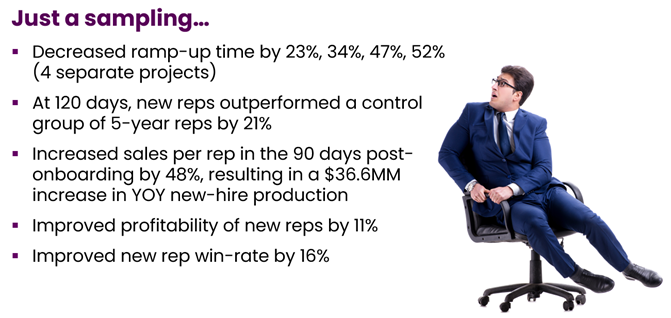
When onboarding is designed around performance milestones, teaches need-to-know content in workflow from left to right, and reinforces learning with practice and coaching, you get faster ramp, steadier execution, and measurable business impact. In implementations using this method, I’ve helped companies both shorten ramp times and increase the productivity of new reps at the same time:
- Ramp-up times: cut by 23%, 34%, 47%, and 52% across four separate companies.
- 120-day performance: new hires outperformed a control group of five-year reps by 21%.
- Post-onboarding impact: in the 90 days after onboarding, sales per rep increased 48%, driving $36.6 million year-over-year new-hire production, with profitability up 11% and win rate up 16%.
Customers feel the difference. They get availability, reliability, and sensible programs—and you get cleaner growth.
Why Training Fails
Training fails when it is misapplied or poorly designed. Common culprits include:
- Wrong content: Training that does not produce real-world results when applied will never move the needle.
- No performance milestones: Without clear checkpoints, onboarding becomes a blur of content with no sense of progress.
- Poor learning design: Information overload, low interaction, and “death by slides” crush retention.
- No sustainment: If you do not plan to beat the forgetting curve, people forget.
- Too few skill development loops: Knowledge without practice does not become skill.
- No transfer plan: If you do not plan how reps will apply what they learned on the job, they won’t.
- Little or no coaching to mastery: One-and-done training does not lead to mastery.
- No measurement plan: When you do not have leading and lagging indicators for both learning and selling, you cannot manage or troubleshoot them later.
- Weak performance management: Managers must inspect what they expect and hold reps accountable for using what they learned.
- No change management: Treating the initiative as an event instead of a managed change effort undermines adoption.
What Else to Avoid in Onboarding
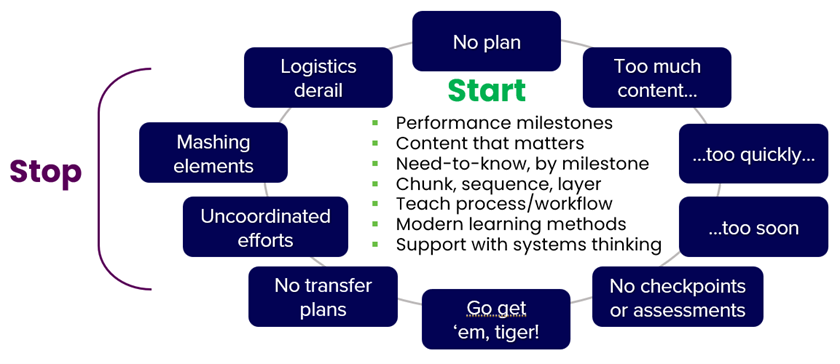
Avoid the patterns that derail even well-intentioned programs:
- Combining logistics, orientation, and onboarding: Uncoordinated efforts derail the job-related learning sellers need to do the work.
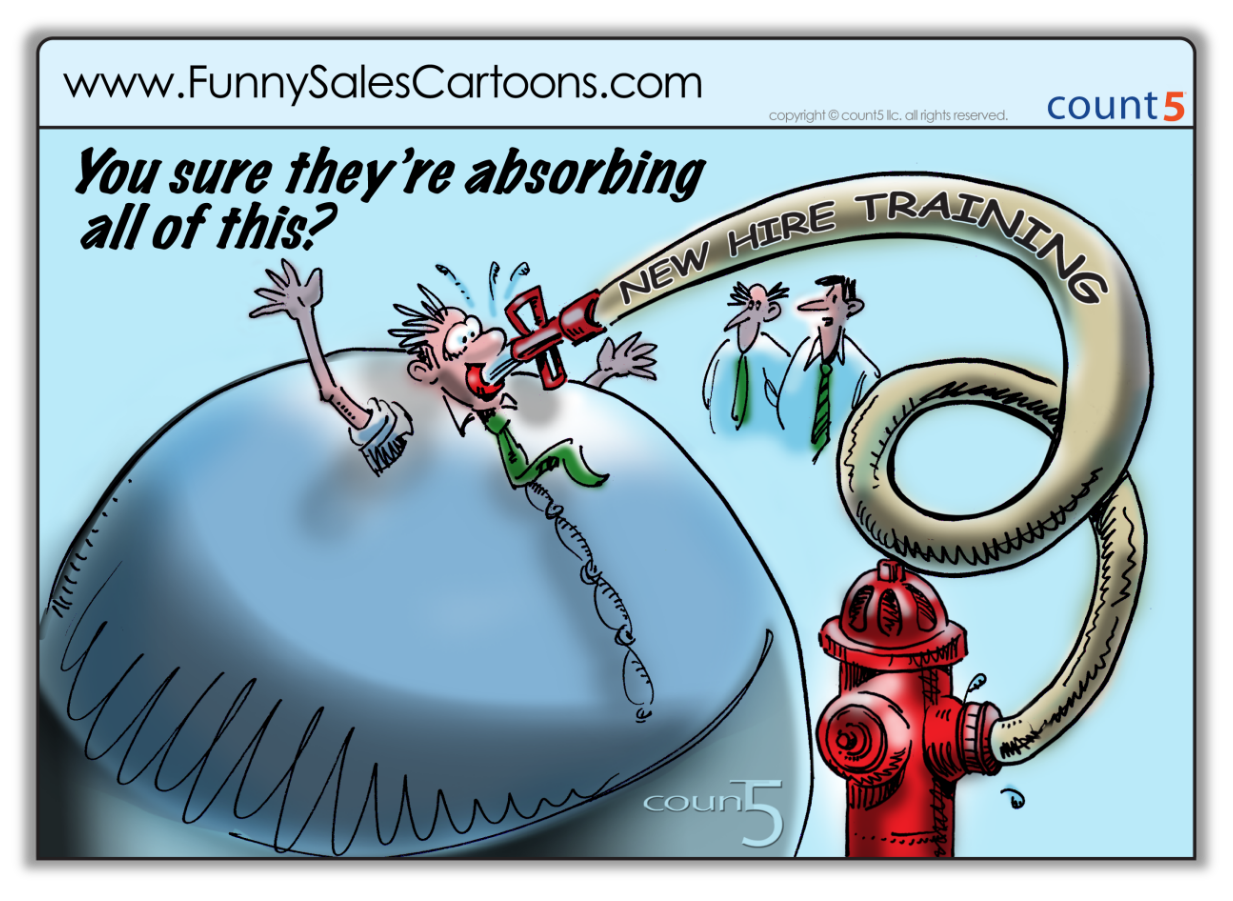
- Too much content, too soon: Cramming everything before it is needed reduces retention and delays execution.
- Slide parades from SMEs: Long, one-way presentations without practice produce very little you can use in the field.
- Event-based approaches: Boot camps with no reinforcement or continued tracking toward milestones become “check the box” experiences.
- No checkpoints or readiness validation: If you do not gate progression, you will advance people who are not ready.
- No sustainment, transfer, or coaching: Without reinforcement and on-the-job application, learning decays quickly.
- “Go get ’em, tiger” launches: Tossing reps into the field because “they’re experienced” ignores how your business actually works.
How to Get It Right
Start With Performance Milestones
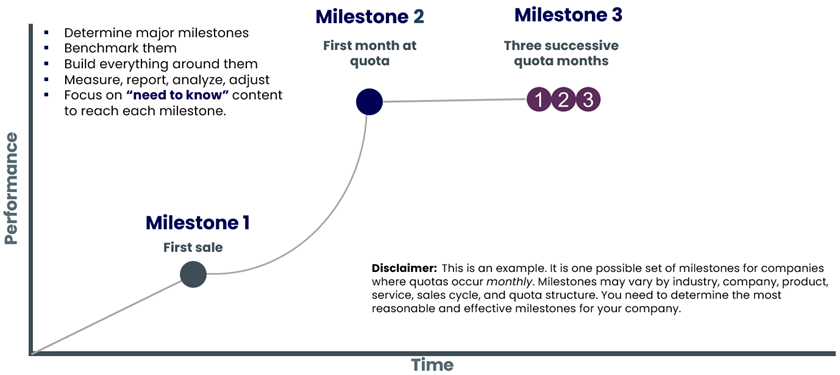
For shorter sales cycles, common examples include the first sale, first month at quota, and three successive months at quota. For longer cycles, expand the count and interval. Track leading and lagging indicators for both learning and selling on the way to each milestone.
- Learning indicators: assessment timing and scores, role-play scoring, readiness validations, or certifications.
- Selling indicators: stage progression, qualified pipeline created, wins, revenue, velocity, profitability.
Teach the Job from Left to Right
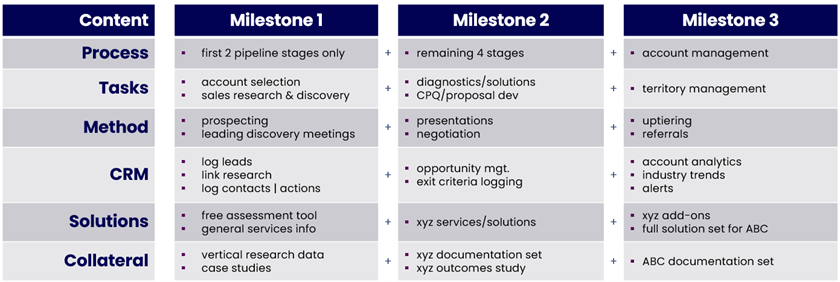
- Chunk the content: Group like topics together in bite-size units.
- Sequence logically: Teach in the order the work happens.
- Layer appropriately: Add new knowledge and skills only when the previous ones have been retained and validated.
For solution roles, teach consultative steps, feasibility checkpoints, and buyer decision requirements that advance complex opportunities. For supplier roles, teach territory coverage strategy, value conversations, pricing hygiene, and the cross‑sell/upsell motions that create growth.
Use Proven Learning Methods
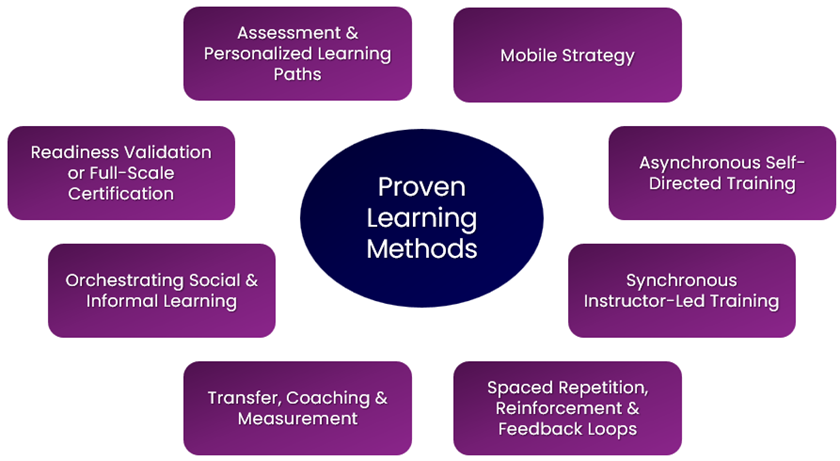
- Bite-sized learning: Break content into small, digestible chunks to improve retention and reduce overload.
- Spaced repetition: Use refreshers at intervals to reinforce learning over time.
- Retrieval learning: Include knowledge checks that require learners to recall information from memory, strengthening retention.
- Flipped classrooms: Keep live time for practice, feedback, and coaching; let knowledge acquisition happen asynchronously.
- Simulations and role plays: Create “deliberate practice loops” that convert knowledge into skill.
- Social and informal learning: Use buddy systems, best-practice sharing, and structured ride-alongs.
- Readiness validation: Use light certifications or skill validations with checklists to gate progression so people advance when ready.
Execute with a Sales Training System
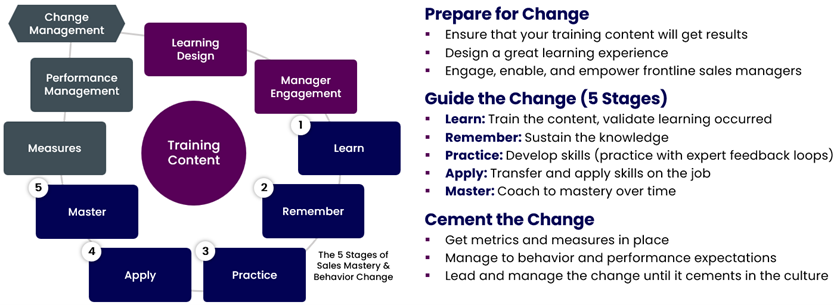
- Learn: Acquire the knowledge with examples and short assessments.
- Remember: Purposefully sustain the knowledge so it is available when needed.
- Practice: Convert knowledge to skill through realistic practice with feedback loops.
- Apply: Transfer and apply skills on the job with job aids and workflow support.
- Master: Coach consistently to raise proficiency and cement behavior.
Example: An Eight-Week Progression for Account Managers
This framework is an example. Context matters and your approach will vary by situation (solution co-creation for IIoT/automation; program stewardship for MRO/consumables). Milestones are the performance checkpoints any AM can hit in a territory.
Week 1: Territory Map and Prioritization
Build a territory map—major sites, buyer personas, influencers, decision flow. Publish a coverage strategy for named/target accounts and a weekly activity plan. Flag at‑risk accounts and high‑potential targets.
- Performance Milestone: map and coverage plan published; manager review complete.
Week 2: Pipeline Creation and Cadence
Create target lists and outreach cadences by segment. Launch campaigns across channels (email, phone, social, events). Clean CRM data (contacts, firmographics, contract references). Book first five discovery meetings.
- Performance Milestone: cadences live; CRM hygiene verified; discovery meetings scheduled.
Week 3: Discovery Quality and Qualification
Run high‑quality discovery. Qualify with discipline. Use a simple meeting rubric (purpose, objectives, plan, outcomes, next steps).
- Performance Milestone five discovery calls completed and qualified; action plans documented.
Week 4: Solution Co‑Creation
For solution roles, co‑plan feasibility conversations with a sales engineer; frame outcomes and decision criteria. For supplier roles, build business‑value options (cross‑sell, upsell, substitutes). Document value hypotheses and success metrics.
- Performance Milestone: one solution path or value option documented with decision requirements.
Week 5: Business Case, Proposal, and Pricing Hygiene
Develop proposals with an executive summary, outcomes, economics, and risk mitigation. Confirm pricing integrity and exceptions. Align approval workflow. Practice negotiation prep—trades, walk‑aways, and agreement language.
- Performance Milestone: one proposal submitted; pricing approvals clean; negotiation plan ready.
Week 6: Advancing Deals and Buyer Alignment
Run proof steps (demos, trials, site walks) where appropriate. Map the buyer landscape—stakeholders, influences, and concerns. Build a mutual action plan with dates and responsibilities.
- Performance Milestone: mutual action plan accepted; deals advancing per plan.
Week 7: Commitment and Handoff
Confirm decision criteria, finalize agreements, and secure commitment. Manage order steps accurately. Set a first value review with the customer to confirm outcomes and address early issues.
- Performance Milestone: one closed‑won or stage progression to final decision; value review scheduled.
Week 8: Next‑90 Plan and Coaching Review
Publish a 90‑day plan—pipeline coverage, quota pacing, target accounts, and activity mix. Document leading indicators (meetings set, discovery completed, qualified pipeline created) and coaching focus areas.
- Performance Milestone: plan approved; leading indicators tracked; coaching cadence set.
Teach Product Depth Without Overload
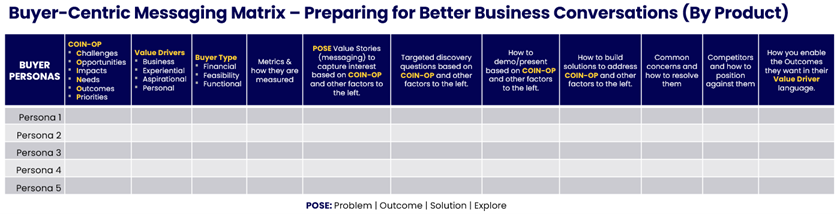
Give them the confidence to prepare for conversations, know when to pull in subject matter experts, and keep discussions centered on business outcomes rather than technical trivia.
Here’s how to make that happen:
- Find answers fast with spec sheets, comparison charts, and job aids.
- Prepare smart with three must‑know questions before any engineering or commercial conversation.
- Use experts wisely (sales engineers for solution lines, product specialists for complex configurations)
- Translate to outcomes—safety, uptime, throughput, cost reduction, compliance, and simplicity.
Coaching from Managers That Improves Performance
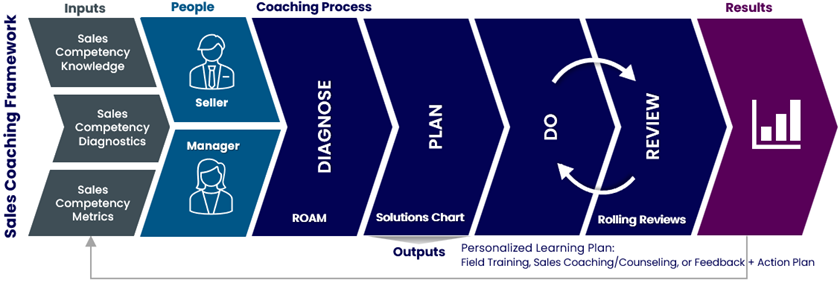
Here’s what that looks like:
- Observe one interaction: program check-in, value review, or feasibility call.
- Score with a simple rubric: purpose clarity, outcomes discussed, next steps confirmed.
- Fix one leak: clean a price file, rewrite a follow-up, update a job aid, remove friction.
- Set one target for next week: a review date, a cross-site introduction, or a cadence improvement.
Light, repeatable, and focused. That is how performance improves weekly, not annually.
Leading Indicators That Predict Results
Dashboards should help managers focus on what drives performance—not drown them in data. While revenue and margin matter, they’re lagging indicators. To improve onboarding outcomes, track the leading indicators that predict success and can be managed week by week.
Examples include:
- Cadence adherence: planned touches for top targets and named accounts.
- Discovery completed: forms completed with quality checks.
- Qualified pipeline created: by segment, stage, and seller.
- Stage conversion rates: diagnose friction and coach to decision criteria.
- Proposal velocity: time from solution alignment to proposal and decision
Lagging indicators still matter—revenue, margin, retention—but manage the leading indicators that create them.
Common Pitfalls to Avoid
Even well-intentioned onboarding plans can go off the rails if you’re not careful. These missteps can derail learning, slow ramp-up, and frustrate both managers and new hires. Here are some of the most common traps—and how to steer clear of them:
- Cramming everything before Week 2: Teach in sequence aligned to workflow; gate progression with readiness checks.
- Shadowing without practice: Pair observation with role plays, simulations, and feedback loops.
- Orphan initiatives: Don’t launch and vanish; put key steps into the weekly cadence and track completion.
- Data mess: Clean CRM and pricing references early; publish an overrides playbook.
- Manager drive‑bys: Coaching can be light, but it must be consistent; set a weekly observe‑score‑fix‑target rhythm.
Closing Thoughts
Onboarding in distribution isn’t a one-size-fits-all checklist; it’s an adaptive system built around your business model and sales motions.
Build a system that mirrors your business—solution co-creation where you sell automation and program stewardship where you run the supplier model. Teach the job left to right, reinforce in small doses, coach weekly, and organize everything around performance milestones. Eight weeks later, you will have sellers who own their territory, keep programs healthy, and move opportunities forward when the line demands it.
Customers get what they care about, availability, reliability, outcomes—and your team gets a cleaner runway for growth.
Related Reading
- The Talent Imperative: Why Investing in Frontline Sales Talent Is the Key to Distributor Growth
- The Real Reasons Distributor Sales Training Doesn’t Stick and What to Do About It
- The Two Buyer’s Journeys in Distribution: A Practical Guide for Sales Leaders
- How to Use Sales Enablement to Build a Culture of Continuous Improvement

Mike Kunkle is an internationally recognized expert on sales enablement, sales effectiveness, sales training, sales coaching, sales management, and sales transformations.
He’s spent over 30 years helping companies drive dramatic revenue growth through best-in-class enablement strategies and proven effective sales systems.
Mike is the founder of Transforming Sales Results, LLC where he designs sales training, delivers workshops, and helps clients improve sales results through a variety of sales effectiveness practices and advisory services.
He collaborated to develop SPARXiQ’s Modern Sales Foundations™ curriculum and authored their Sales Coaching Excellence™ and Sales Management Foundations™ courses.
Mike's book, The Building Blocks of Sales Enablement, is available on Amazon, with others coming soon in 2026, starting with The CoNavigator Method for B2B Selling.