



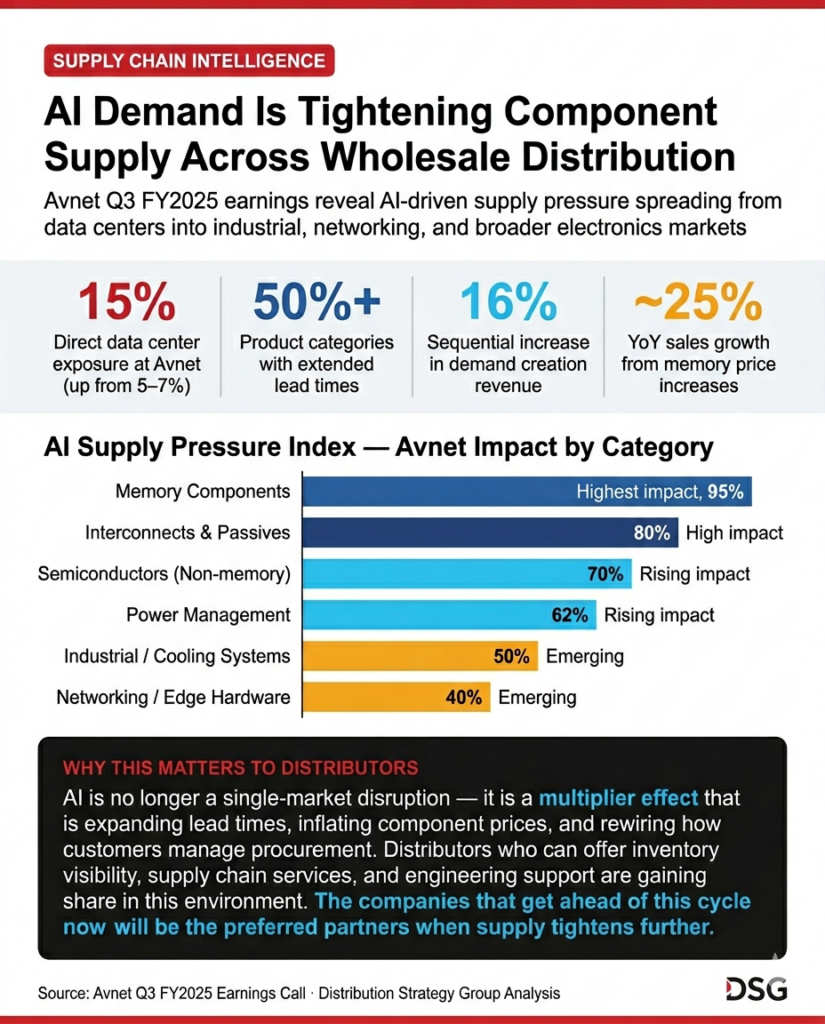
Why This Matters to Distributors: AI is expanding beyond hyperscale data centers into industrial, networking, and component markets, tightening supply, extending lead times, and increasing pricing pressure across a broader range of products.
Artificial intelligence demand is moving beyond data centers and beginning to reshape the broader electronics supply chain, driving tighter component availability, rising prices and stronger demand across multiple end markets, executives at Avnet said on the company’s fiscal third-quarter earnings call.
Chief Executive Officer Philip Gallagher said AI-related demand is no longer confined to a single segment but is contributing to growth across the company’s core markets.
“As data center and AI demand proliferates throughout the market, we also saw broad-based demand across most of our core end markets,” Gallagher said.
Avnet said its direct exposure to AI-driven data center demand has increased in recent quarters.
Gallagher said the company’s exposure has risen from about 5% to 7% to 10% to 15% of its business directly to data centers.
He said the larger impact is coming from indirect demand, as AI infrastructure drives growth in adjacent sectors such as industrial systems, power management, and cooling.
“What we try to track is what other verticals are being impacted with the expansion of data center,” Gallagher said, noting that industrial applications are seeing increased demand linked to AI buildouts.
The expansion of AI infrastructure is also increasing demand for supporting components, not just semiconductors.
Gallagher said the company’s interconnect, passive and electromechanical business benefited from what he described as a “multiplier effect,” as AI systems require a wide range of supporting parts.
“Every active semiconductor chip requires surrounding components to function,” he said, citing connectors, capacitors, resistors, and sensors.
Supply constraints are beginning to widen beyond AI-specific components.
Avnet said lead times increased across more than 50% of the product categories it tracks, including semiconductors and interconnect products.
“Lead time extensions continue in components supporting data center and AI builds,” Gallagher said. “They are now spreading to a broader set of products supporting diverse end market applications.”
Executives said lead times remain most pronounced in memory-related products but are beginning to extend modestly in other categories.
Rising demand tied to AI is also contributing to higher component prices, particularly in memory.
Chief Financial Officer Ken Jacobson said memory pricing was a major factor in recent sales growth.
“Approximately half of the sequential sales growth and approximately one quarter of the year-on-year sales growth was attributable to higher memory pricing,” Jacobson said.
He said additional price increases are expected in coming months, though increases outside of memory are likely to be less significant.
As supply tightens, customers are changing how they manage procurement and inventory.
Gallagher said customers are increasingly relying on distributors to help manage supply chain complexity.
“Customers are increasingly recognizing the challenges of a tightening supply environment and are turning to Avnet’s expertise to help manage their component supply chains,” he said.
The company reported growing backlog and book-to-bill ratios above parity in all regions, indicating demand continues to outpace shipments.
To support rising demand, Avnet said it is expanding investments in digital tools, engineering resources, and supply chain services.
The company reported a 16% sequential increase in demand creation revenue, supported by digital design capabilities and engineering support tied to complex system builds.
“Our demand creation revenues increased sequentially by 16%, and leading indicators remain positive,” Gallagher said.
Executives said the current environment reflects the initial stages of a broader market shift, with AI acting as a catalyst for demand across the electronics ecosystem.
The impact is extending beyond data centers into industrial, networking, and other end markets, while also tightening supply conditions and increasing pricing pressure.
For distributors, the shift is expected to increase the importance of inventory management, supply chain visibility and value-added services as customers navigate a more constrained and complex sourcing environment.
Do not miss any content from Distribution Strategy Group. Join our list.
Share this article:
