

Why This Matters to Distributors: Lowe’s is expanding its push into professional distribution beyond its acquisitions of Foundation Building Materials and Artisan Design Group. The company says it is actively pursuing additional tuck-in deals while integrating the businesses, expanding Pro-focused products and using digital tools and fulfillment to capture more of contractors’ planned project spending.
Lowe’s Cos. is preparing to expand its building products distribution business through additional acquisitions as it pushes for a larger share of professional contractor spending.
The home improvement retailer said it is “pursuing aggressively tuck-in opportunities” around Foundation Building Materials and Artisan Design Group, two acquisitions that have moved Lowe’s deeper into specialized distribution and larger professional accounts.
“We’re pursuing aggressively tuck-in opportunities where those exist, and we expect to emerge on the backside of this as a more scaled player,” chief financial officer Brandon Sink said during Lowe’s Aug. 19 second-quarter earnings call.
The comments provide a clearer picture of Lowe’s business development strategy following its acquisitions of Foundation Building Materials, or FBM, and Artisan Design Group, or ADG. Lowe’s is using the businesses to broaden its reach with larger contractors and builders while looking for additional acquisitions that could add scale.
CEO Marvin Ellison said Lowe’s is making progress integrating the businesses and looking for ways to combine their capabilities.
“Our teams continue to work closely together to share best practices and build solutions for our customers,” Ellison said. “We believe these acquisitions position us to grow share with our larger Pro customers long-term while capturing more planned Pro spend.”
The strategy increasingly puts Lowe’s in competition with traditional building products distributors, particularly for purchases planned around projects rather than individual trips to a home improvement store.
Lowe’s Pro business grew again during the second quarter, led by small and midsize contractors. Executive Vice President of Stores Joe McFarland said the company is concentrating its investments on three areas it believes matter most to those customers: time, product availability, and value.
“We know our Pros value three things above all else: time, availability and value, and that’s exactly where we focused our investments,” McFarland said.
Lowe’s is also trying to move further into contractors’ purchasing processes through its digital Pro Business tools and MyLowe’s Pro Rewards program.
“These expanded tools support Pros by enabling them to plan, quote, manage, and grow their business all within the Lowe’s platform,” McFarland said.
The company is pairing those capabilities with a broader assortment aimed at tradespeople. Lowe’s reported growth in rough plumbing, millwork, electrical and lumber during the quarter, which management linked to its Pro investments and continued demand for repair and maintenance projects.
Lowe’s also plans to add hundreds of power tools, hand tools, and storage products, including more than 150 new DeWalt items aimed at DIY and Pro customers.
“We’ve had Rough Plumbing with six straight quarters of positive growth,” executive vice president of merchandising Bill Boltz said. “Paint, Electrical, Millwork, all four- and five-consecutive quarters of positive growth.”
The Pro gains came as Lowe’s overall sales increased sharply from a year earlier, although much of that increase reflected the addition of its acquired businesses.
Sales increased 8.3% to $25.96 billion for the quarter ended July 31 from $23.96 billion a year earlier. Net earnings were unchanged at $2.40 billion. Comparable sales, which provide a better measure of activity in Lowe’s existing business, increased 0.2%. Management said continued strength in Pro helped offset weak discretionary spending by do-it-yourself customers.
For the first six months of the year, sales increased 9.2% to $49.03 billion from $44.89 billion. Net earnings declined 0.3% to $4.03 billion from $4.04 billion.
The Pro expansion is taking place against a difficult construction market.
Lowe’s said its survey of core Pro customers found that project backlogs remain steady, but contractors are dealing with homeowners who are more cautious about spending. That is shifting activity toward smaller repair and maintenance projects instead of larger remodeling jobs.
“Our core Pro customers shared that their backlogs are steady,” McFarland said. “However, they are seeing a homeowner that is more cautious about their spending.”
That slowdown is particularly important for Lowe’s recently acquired distribution businesses.
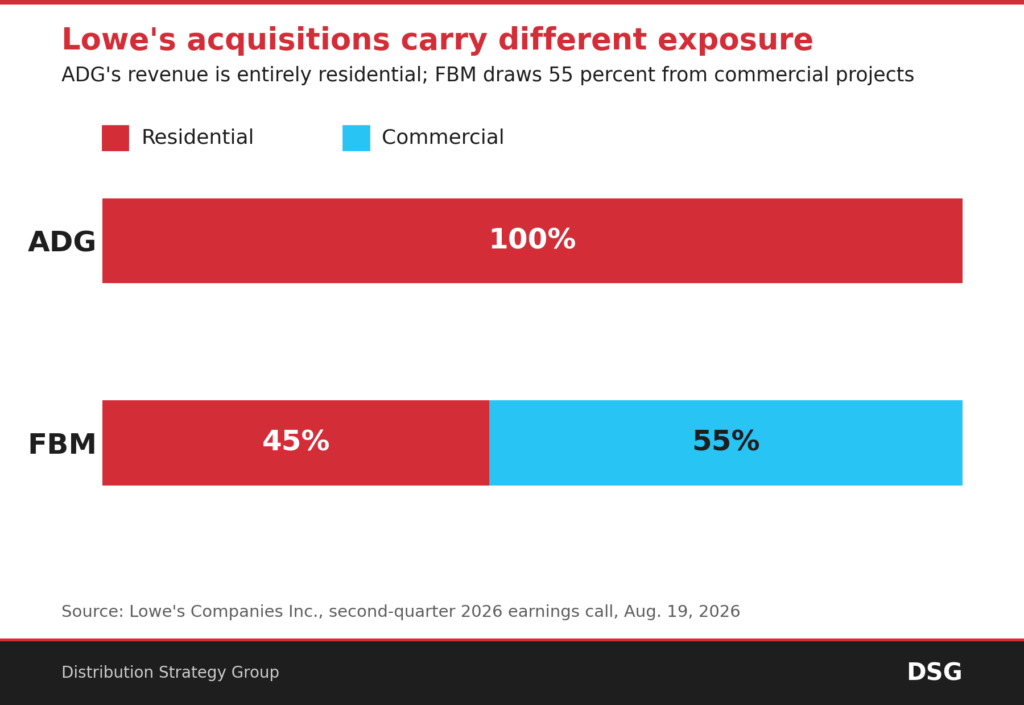
ADG is entirely exposed to residential construction, while about 45% of FBM’s business is tied to residential construction. The remaining 55% of FBM’s business is commercial, an area Lowe’s said continues to perform well.
Sink said weaker residential construction is affecting both companies, but Lowe’s is continuing with integration work and acquisition activity rather than waiting for the market to recover.
“FBM’s business, we are and continue to be pleased with the commercial business, which represents 55%,” Sink said. He added that continued pressure on residential construction is affecting FBM and ADG.
Lowe’s said it views FBM and ADG as long-term growth platforms that can help it take additional share in home improvement and residential construction as demand recovers.
Ellison said the company does not intend to pull back from that strategy because of current housing conditions.
“This is a really difficult single-family and multifamily construction environment, but it’s not going to always be that way,” Ellison said. “We know at some point we’re going to have to build houses in this country, and when we do, we’re better positioned today and we’ll be better positioned in the future than we’ve ever been in the history of this company.”
For distributors, the bigger development is the structure Lowe’s is assembling around its Pro strategy.
The company is combining specialized distribution businesses with its store network, expanding contractor-focused assortments, investing in digital quoting and account-management tools, and building fulfillment capabilities designed to capture a larger portion of project spending.
Now Lowe’s is signaling that more acquisitions could be added to that network.
That shifts the competitive battle beyond the home-center aisle. Lowe’s is increasingly competing for the broader contractor relationship — including project planning, quoting, product availability and fulfillment — that has traditionally been central to wholesale distribution.
Do not miss any content from Distribution Strategy Group. Join our list.
Share this article:
