



Why This Matters: Manufacturing expanded for an eighth straight month in August, but slower new orders and backlogs combined with persistent price increases and longer supplier delivery times signal a more challenging operating environment for industrial distributors.
U.S. manufacturing expanded for an eighth consecutive month in August, but the pace slowed as new orders, employment and order backlogs weakened while manufacturers continued to contend with high input costs and supply-chain constraints.
The Institute for Supply Management’s Manufacturing Purchasing Managers’ Index fell to 54.6% in August from 55.6% in July. A reading above 50% indicates the manufacturing sector is generally expanding.
The August results show an industrial economy that continues to grow but lost some momentum from July. New orders, production, employment and order backlogs all remained in expansion territory, although each grew at a slower pace.
New orders fell 3 percentage points to 53.7% from 56.7% in July, while the backlog of orders index dropped 3.2 percentage points to 51.8% from 55%. Production remained comparatively strong at 58.3%, down slightly from 58.5% a month earlier.
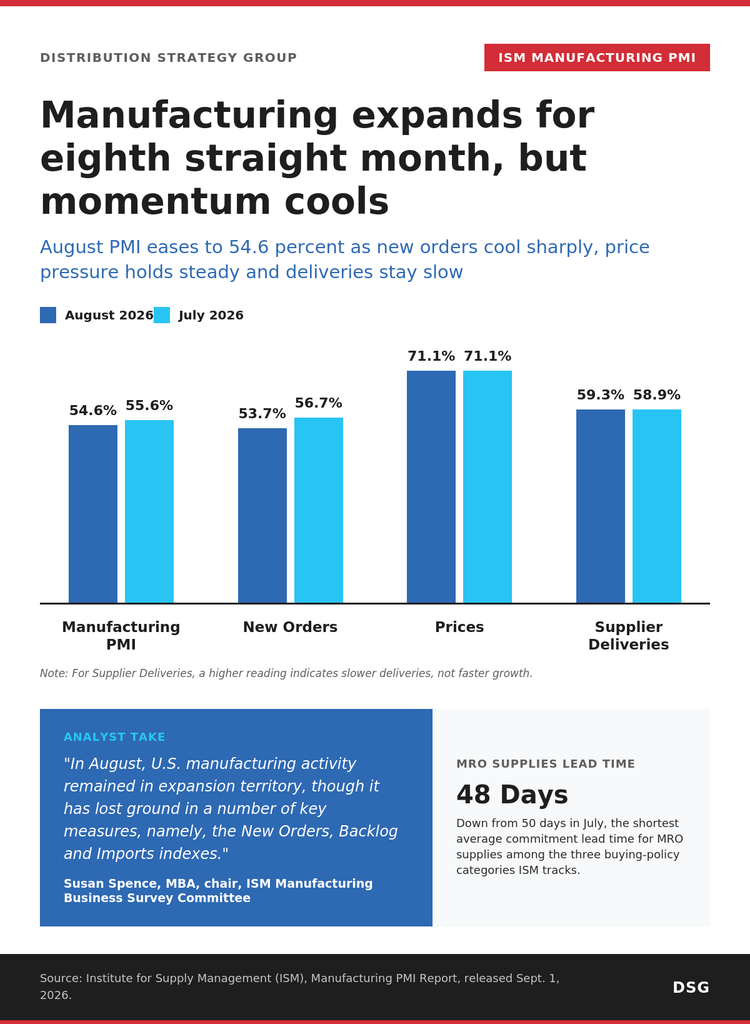
“In August, U.S. manufacturing activity remained in expansion territory, though it has lost ground in a number of key measures — namely, the New Orders, Backlog and Imports indexes,” said Susan Spence, chair of the ISM Manufacturing Business Survey Committee.
The slowdown in demand was accompanied by continued pressure on manufacturers’ supply chains and costs, two areas with direct implications for industrial distributors.
ISM’s prices index remained at 71.1% in August, unchanged from July and marking the 23rd consecutive month of rising raw material prices. ISM attributed the continued pressure in part to higher steel and aluminum prices, tariffs on imported goods and increases in petroleum-based products.
Manufacturers reported higher prices for aluminum, chemicals, copper, electrical and electronic components, freight, metal products, resins, semiconductors, steel and wire. Copper, electrical and electronic components, memory products, printed circuit boards, steel and tungsten products were among the materials reported in short supply.
Supplier deliveries also slowed further. ISM’s supplier deliveries index increased to 59.3% from 58.9% in July, marking the ninth consecutive month of slower deliveries. A reading above 50% indicates suppliers are taking longer to deliver products.
Comments from manufacturers pointed to mounting concern about the combination of availability and pricing pressures.
“Supply markets are increasingly challenging due to inflation and supply availability,” one computer and electronic products manufacturer said. “Each month has been more difficult than the previous one. Starting to resemble the post-COVID-19 disruptive period.”
A machinery manufacturer reported similar cost pressure.
“Prices continue to rise on all goods,” the respondent said. “Suppliers are noting that energy, steel and labor costs are increasing very quickly.”
Employment provided another sign of moderating growth. ISM’s employment index fell 1.6 percentage points to 51.2% from 52.8% in July. Among the six largest manufacturing industries, only transportation equipment reported higher employment in August.
Despite the slowdown in several key measures, growth remained broad across manufacturing. Fifteen industries reported expansion in August, while wood products and chemical products reported contraction.
Five of the six largest manufacturing industries expanded: transportation equipment; petroleum and coal products; computer and electronic products; machinery; and food, beverage and tobacco products.
One potentially positive signal for distributors was customer inventory levels. ISM’s customers’ inventories index increased to 42.8% from 40.7% but remained in what ISM considers “too low” territory. Low customer inventories are generally considered positive for future production because customers may eventually need to replenish stock.
Purchasing lead times remained lengthy but improved slightly during August. The average commitment lead time for production materials declined to 84 days from 87 days in July, while maintenance, repair and operating supplies fell to 48 days from 50 days. Capital expenditure commitments averaged 171 days, compared with 172 days in July.
For distributors, the August report points to continued industrial demand but a less straightforward growth environment than the headline PMI suggests. Customers are still producing and placing orders, but slower growth in new orders and backlogs is occurring alongside high material prices and continued supply constraints, increasing the importance of inventory, sourcing and pricing decisions.
Do not miss any content from Distribution Strategy Group. Join our list.
Share this article:
