

Nearly half of distributors admit they’re not very good at pricing, a capability more important than ever now that ever-changing tariffs continually disrupt what they pay for products. Those distributors are leaving profits on the table and falling behind rivals that invest in the existing, effective tools for optimizing product price and, increasingly, in the power of artificial intelligence.

“Distributors are getting better at pricing, but slowly compared to other technologies we look at in our best practices series,” Jonathan Bein, managing partner and co-founder of consulting firm Distribution Strategy Group, said on a recent webinar entitled The State of Pricing and Costing. “There’s a big opportunity for distributors to deploy pricing to get more margin. We know distributors use pricing as a way to build wealth, literally.”
Bein and co-presenter Lee Nyari, managing partner of pricing consultancy The Innovative Pricing Group LLC, explained the strategies that differentiate distributors that price effectively from those that don’t.

They said companies pricing effectively offer value-added services and technical services that allow them to charge more and also look for ways customers can help them reduce costs, discussions that avoid the touchy subject of price.
Bein and Nyari were reporting on a DSG survey of 128 distributors about their pricing practices and strategies. While the survey found only a minority of respondents are using AI today in pricing-related tasks, those distributors are among the most effective pricers, taking advantage of AI capabilities that already can compile data more quickly than humans can and flag pricing errors quickly.
How Are Distributors Pricing in Tariffs
Of course, any discussion of distributor pricing these days must address the question of tariffs, which have raised prices for many of the goods distributors sell.
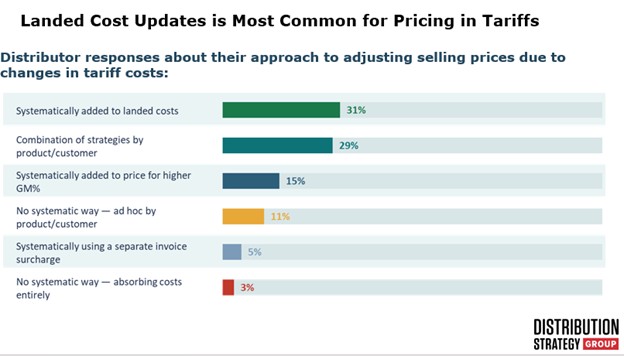 The survey found the largest segment, 31%, simply add the tariff to the landed cost of the product, while another 29% apply various strategies depending on the product and customer. Others vary their pricing by gross margin percentage or just ad hoc by product and customer. Just 3% absorb all the costs of tariffs, suggesting the vast majority are passing along the higher import duties.
Interestingly, only 5% indicate a tariff surcharge on the invoice. That may come into play in the near future as importers demand refunds for certain Trump administration tariffs recently deemed illegal by the Supreme Court—potentially leading to distributors’ customers asking for those surcharges to be refunded.
Nyari pointed out that the diversity of distributor practice makes sense, given that each company is impacted differently by tariffs. Plus, he said, there is broad uncertainty about what will happen next.
Just Over Half of Distributors Say They Price Effectively
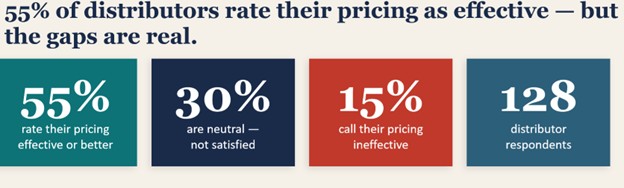
When asked if they price effectively 55% of respondents to the DSG survey said they did, 15% said they didn’t and 30% were in between. It’s worth noting that respondents to DSG surveys tend to be more advanced practitioners and the percentage of under-performing companies in the overall market is probably higher.
The most popular strategy for setting prices is cost-plus, simply adding a certain percentage to the cost of the item. That’s relatively simple, because every distributor knows what it pays for goods, and that approach ensures you never sell at a loss.
The downside to cost-plus is that often many distributors sell the same products and if you only vary price by product cost you’re competing with competitors solely on price, inevitably undermining profit. No surprise then, that the distributors that rate themselves as ineffective at pricing are the most likely to go the cost-plus route.
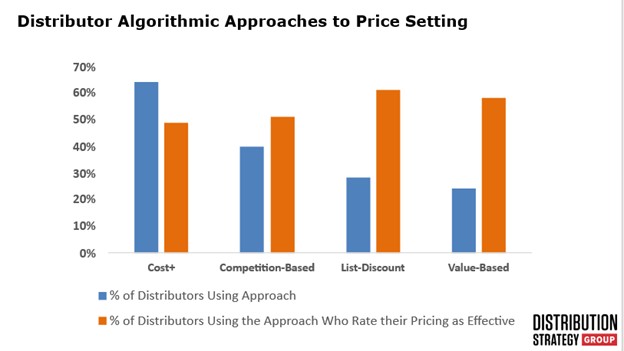 Others use a competition-based approach, focusing on what competitors are doing. But, Nyari pointed out, this approach means “your pricing is only as smart as your competitor’s. And if our competitor pays attention to you, you can end up with a race to the bottom.”
Another approach that Nyari says is better than cost-pus is the list-discount option that takes into account a variety of factors that may warrant different discounts for different customers. But it lacks the “built-in safety net” of cost-plus pricing and may require a more robust discount structure to manage the varying discounts
The value-based approach is where the most effective distributors show up much more often than their less-effective rivals. These companies price based on the value they deliver to customers, which includes the value-added services and technical expertise they offer. This value-added approach plays a big role in the strategies that differentiate effective pricers.
Five Ways Distributors Optimize Their Pricing
In the webinar, Nyari and Bein highlighted five ways top performers maximize their profits via pricing:
- Structure: They price by segment, which may be product, customer, geography or other factors. 41% of distributors ineffective at pricing use no segmentation strategy at all, which puts them at a big disadvantage.
Among the segmentation methods more sophisticated companies use are cubes or matrices that allow a distributor to look at each pricing decision by several key variables, variables that will be specific to each customer. For some, geography, product and size of customer may be crucial, while another may focus on cost to serve, low- versus high-velocity products, or other factors.
An even more effective way to structure pricing decisions is to use “trees,” which break down decisions at many levels. In the webinar, Nyari showed an example of a tree that first segmented by U.S. versus non-U.S. customers, then by product line, then by direct sales versus sales to other distributors.
A decision tree allows each distributor to focus on the factors most important to its customers. Nyari cited an example of a distributor that found for certain customers proximity to the distributor’s fulfillment center was important. “For other customers, that didn’t matter at all.” A decision tree can segment out the customers and products for which distance to a warehouse is important and price for just that segment.
Nyari noted that most providers of pricing software build decision trees into their products.
- Price on value: The distributors best at pricing often can charge more based on the value they bring to customers. In some cases, that may be because they have the exclusive right to distribute a popular product in a particular geography, or because they offer exceptional customers service, technical expertise or value-added services.
Pricing on value avoids the race-to-the-bottom risk that comes from cost-plus pricing or trying to stay ahead of your competitors. - Invest in pricing capability: Distributors that are good at pricing invest in it. 24% of them use third-party pricing software versus 18% of those who say they price poorly. There’s an even bigger difference when it comes to AI: None of those who rated themselves ineffective at pricing are using AI, while 29% of the effective pricers said they were beginning to build AI into their business.
While AI in pricing is still in its early stages, Nyari says an AI bot can help in preparing quotes by quickly gathering large amounts of data that feed into those quotes. “Bots can also flag price leaks in real time,” he said. For example, if a salesperson wants to override a pricing policy, the bot can analyze whether that’s desirable and quickly recommend whether to approve that discount, - Differentiated value-added services: Bein described value-added services as anything that goes beyond such core functions of a distributor as product availability, assortment and service. Examples include selling multiple products as a kit, assembling products, vendor-managed inventory or product configuration. For instance, a distributor selling electrical cable to data centers or utilities can add value by cutting the cable to customers’ specifications.
The takeaway: Customers will pay more when distributors do more for them. - Finding ways for the customers to help you: Even if two customers pay the same price, one may be more profitable for the distributor because it orders in larger quantities, provides accurate forecasts of its needs or is more flexible about delivery times. A particular customer may be especially valuable because its business gives you a foothold in a product category or geography you hope to penetrate.
Think about ways to work with customers not just to increase revenue but also to decrease costs to serve. That’s a way to bolster the bottom line without raising prices.
